

Self-conscious – English Flashcard for Self-conscious
Self-conscious Self-conscious (adj) /ˌselfˈkɒn.ʃəs/ US /-ˈkɑːn-/ much too uncomfortable and concerned with your appearance, actions and presence in public places […]
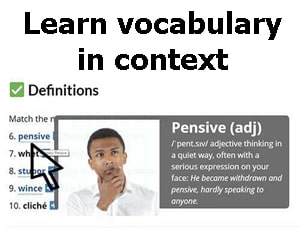
Learning English vocabulary, especially abstract and academic words, has always been a big challenge for English learners because the majority of ESL learners simply memorize words out of context. Therefore, English learners cannot score high on standardized English tests, such as IELTS, TOEFL, GRE, SAT, etc. with relatively long passages and contextualized words.
Vocabulary learning should be integrated with listening comprehension to become a more natural process. For this reason, our students can select any word, phrase, passage or the entire article in order to listen to the selected text. That is to say, LELB Society is genuinely talking to and interacting with our students.
As mentioned earlier, it’s a wrong approach to learning vocabulary out of context. At LELB Society, we provide our students with this exceptional opportunity to build up and expand academic vocabulary in real or authentic context extracted from novels, books, websites, plays, scripts of movies, poems, and the like. What’s more, our students can master advanced vocabulary in organized themes and subjects by clicking on the tags or keywords located at the bottom of each lesson. To browse our most frequently-used tags and keywords, click here and study all lessons.
Abstract words should become tangible in your mind for a longer retention. One perfect way to make abstract words tangible is to make appropriate associations between them and corresponding visual concepts, and using images and illustrations can help you achieve this goal. At LELB Society, we have illustrated thousands of advanced English vocabulary found in best-selling vocabulary books, such as 504 Absolutely Essential Words, 1100 Words You Need to Know and 601 Words You Need to Know to Pass Your Exam.
The images and illustrations are accessible only to our students or members.
Self-conscious Self-conscious (adj) /ˌselfˈkɒn.ʃəs/ US /-ˈkɑːn-/ much too uncomfortable and concerned with your appearance, actions and presence in public places […]

Accustomed Accustomed (adj) /əˈkʌs.təmd/ 1. being familiarized with or habituated to something – familiar: As a miner, he was accustomed […]

Mechanics Mechanics (noun) /məˈkæn.ɪks/ the detailed procedure and mechanism of something that works or functions – mechanism – procedure – […]

Extol Extol (verb) ɪkˈstəʊl/ US /-ˈstoʊl/ to praise somebody or something excessively – admire – exalt: This book is aimed […]

Internal Internal (adj) /ɪnˈtɜː.nəl/ US /-ˈtɝː-/ occurring or existing inside a person, organization, place, country, object, etc. – intrinsic: He […]

Susceptible Susceptible (adj) /səˈsep.tɪ.bļ/ easily affected or influenced by something – vulnerable – at stake – liable: Stress can undermine […]

External External (adj) /ɪkˈstɜː.nəl/ US /-ˈstɝː-/ occurring or existing outside a person’s body, country, organization, place, object, etc. extraneous, superficial […]

Age-old Age-old (adj) /ˈeɪdʒˌəʊld/ US /-ˌoʊld-/ existing for a long period of time – ancient – long-existing: the age-old issue […]

Enduring Enduring (adj) /ɪnˈdjʊə.rɪŋ/ US /-ˈdʊr.ɪŋ/ continuing and existing for a very long period of time – lasting: It was […]