Table of Contents
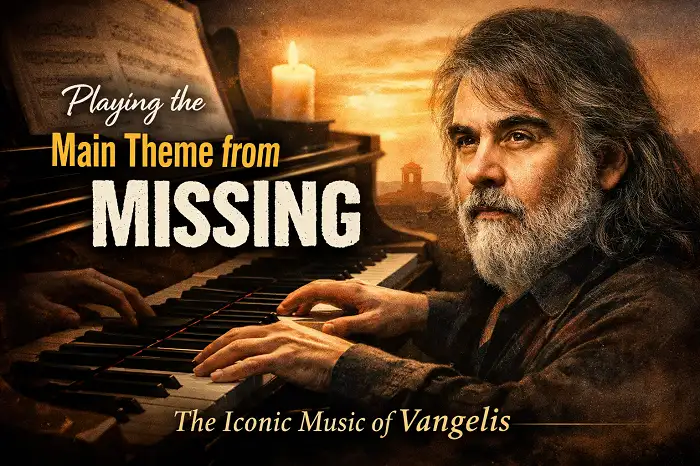
Dr. Mohammad Hossein Hariri Asl performs the Main Theme from Missing on keyboard, offering a personal and expressive interpretation of this memorable film melody. This performance focuses on conveying the emotional depth of the music rather than technical complexity, highlighting the lyrical and reflective nature of the piece.
Video of Main Theme from Missing

Main Theme from Missing
The main theme from Missing is a minimal yet powerful composition that captures feelings of uncertainty, loss, and quiet resistance. Its slow tempo and simple melodic structure allow each note to resonate, making the theme emotionally compelling despite its apparent simplicity.
Because of its openness and sparse harmony, the theme invites individual interpretation. When played on a keyboard, subtle changes in touch, timing, and dynamics can significantly shape the emotional impact, turning the performance into a personal musical narrative rather than a strict reproduction.
The Film Missing (1982)

Missing is a political drama film directed by Costa-Gavras, released in 1982, and based on real events surrounding the 1973 military coup in Chile. The story follows the search for an American journalist who disappears during the political turmoil, as his wife and conservative father confront bureaucracy, denial, and harsh political realities. Starring Jack Lemmon and Sissy Spacek, the film was widely acclaimed by critics, won the Palme d’Or at the Cannes Film Festival, and remains highly rated on IMDb for its powerful performances, moral depth, and strong political message.
Vangelis: Short Biography

Vangelis (Evangelos Odysseas Papathanassiou) was a renowned Greek composer best known for blending electronic sounds with cinematic expression. He often composed intuitively, preferring real-time improvisation over written scores, which gave his music a spontaneous and deeply human quality.
He gained worldwide recognition through his film soundtracks, including Chariots of Fire, Blade Runner, and Missing. Vangelis viewed electronic instruments as emotional tools rather than technical devices, and his music continues to influence composers, performers, and listeners across genres for its atmospheric depth and expressive freedom.