Table of Contents
- Video of Computer-Mediated Communication in Language Learning
- Definition and Scope of Computer-Mediated Communication
- Historical Background of CMC
- CMC and Language Learning
- Instructional Techniques in CMC Environments
- Collaborative Computer-Mediated Communication Technique (ColCMC)
- Cooperative Computer-Mediated Communication Technique (CopCMC)
- Empirical Research on CMC
- Smith (2003)
- Smith (2004)
- Paran, Furneaux and Sumner (2004)
- Abrams (2001)
- Pedagogical Implications of CMC
- CMC as a Multidimensional Learning Environment
- References
Computer-Mediated Communication (CMC) has become a fundamental component of modern language teaching and learning. This post examines how CMC environments, tools, and strategies support interaction, collaboration, and authentic language use. By reviewing definitions, historical developments, instructional techniques, and influential research studies, readers will gain a clear understanding of how CMC reshapes second language pedagogy and enhances learners’ communicative competence across digital platforms.
Video of Computer-Mediated Communication in Language Learning

Definition and Scope of Computer-Mediated Communication
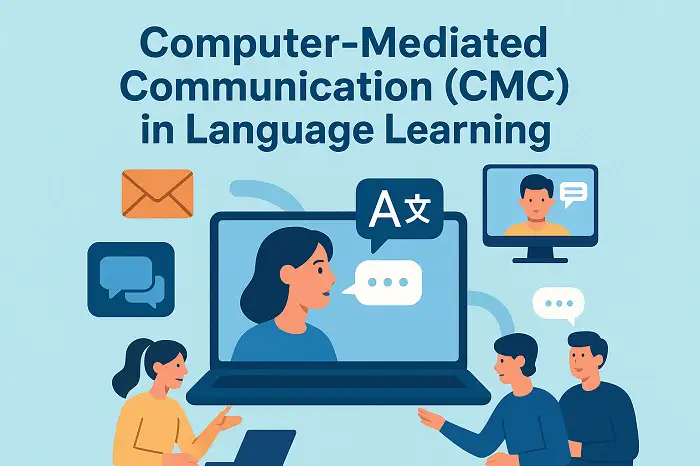
CMC is a research area regarding communication that takes place among human beings through the instrumentality of computers (Herring, 1996). CMC includes email, video-conferencing, IRC, commenting, posting, etc. because it investigates the nature of communication via text, audio and video on the computer (Harrington & Levy, 2001; Kinoshita, 2008). It is important to add that text-based CMC took precedence over its audio and video-based versions chronologically speaking (Kinoshita, 2008).
Historical Background of CMC
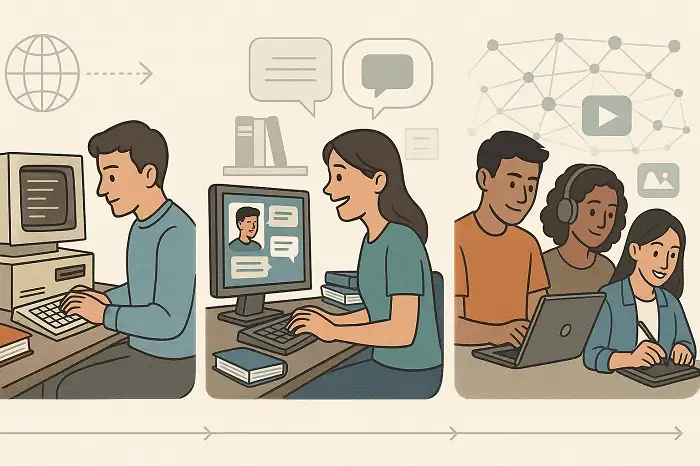
About the history of computer-mediated communication, it is interesting to note that CMC was first considered a sub-field of business communication; however, the blending of multimedia in the traditional business environment is deteriorating this distinction, as mediated communication is immersed in almost any business communication context, perhaps even coming to take control of certain areas as public relations (Jackson, 2007).
CMC and Language Learning
Sokolik (2001) defines CMC in this way:
The most common use of networked computers is as a tool of communication between users. This makes it a natural choice as a tool for language learning. Many researchers have argued that CMC presents an opportunity for authentic language use, making it an excellent tool in the language classroom (p. 483).
Instructional Techniques in CMC Environments

The following two techniques can be implemented in order to teach second languages to students in computer-mediated environments (AbuSeileek, 2007):
Collaborative Computer-Mediated Communication Technique (ColCMC)
-
Collaborative Computer-mediated Communication Technique (ColCMC): A computer is used as a tool for communication between the teacher and class. That is to say, it is based on using the teacher to whole class (collective) method of learning in a computer-mediated fashion. It has nothing to do with students interacting with other classmates in groups or pairs. In other words, each student individually receives the questions, listens to the text, thinks of an answer and responds to the teacher.
Cooperative Computer-Mediated Communication Technique (CopCMC)
-
Cooperative Computer-mediated Communication Technique (CopCMC): Students are divided into small groups or pairs to perform a task through using the computer as a means for communication between the pairs or members of the group. The use of this technique in learning oral skills (listening and speaking) is supposed to enable the students to work at their own pace.
Empirical Research on CMC
Smith (2003)
Smith (2003) conducted a study on the use of communication strategies in task-based computer-mediated communication. The results indicated that an appropriate CMC environment in which learners are encouraged to have social interaction with each other can assist them with utilizing a wide variety of communication strategies and improving their communicative competency.
Smith (2004)
Smith (2004) undertook an experimental study, testing the Interaction Hypothesis in a computer-mediated communicative environment in which 24 intermediate non-native speakers of English interacted with one another in a synchronous mode over a local area network (LAN), attempting to jointly complete jigsaw and decision-making tasks seeded with largely unknown target lexical items. The data suggested that the level of negotiated interaction increases when the learners are exposed to unknown lexical items. This hypothesis was also confirmed that previously unknown lexical items that were fairly negotiated were subsequently retained significantly better.
Paran, Furneaux and Sumner (2004)
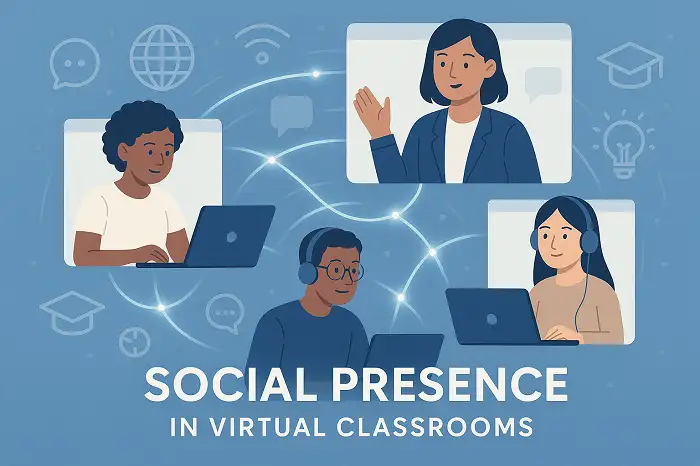
Paran, Furneaux and Sumner (2004) undertook a CMC-based study on M.A. students of TEFL who used email discussion lists and boards. Data were collected from 63 open-ended questionnaires and six in-depth interviews with the students in a qualitative mode. The results revealed that with the intention of increasing the level of interactivity among the students in online environments, CALL program leaders may need to give more consideration to learner training and CALL program restructuring.
Abrams (2001)
Abrams (2001) carried out a study to compare and contrast CMC contexts with traditional group journals to examine whether the former could promote the adoption of a wider array of participant roles that can prepare the learners better for authentic interactive situations compared to the latter. The findings revealed that CMC contexts are more effective than traditional group journals in encouraging the learners to develop the necessary scholastic skills to co-construct the discourse of their interactions, to actively take on a vast array of requisite participant roles so that the learners could be successful participants and authors of what occurs in the classroom, as opposed to being solely reactors to the teacher’s directions.
Pedagogical Implications of CMC

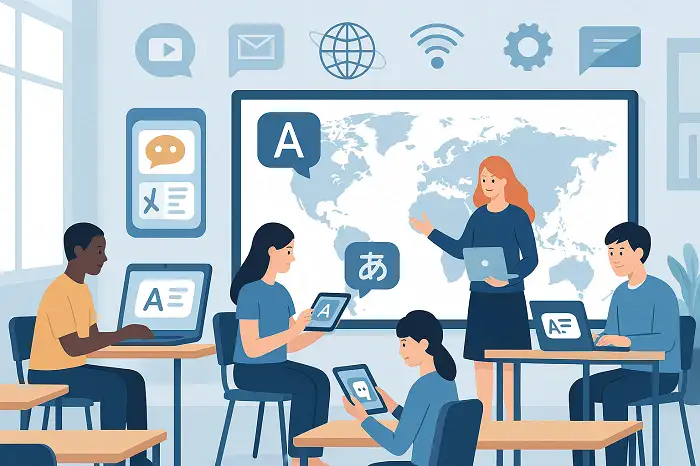
CMC provides a novel way for teachers to run classroom conversations, particularly when the goal is to get students to participate by using language to negotiate meaning, and when learners need opportunities to produce the target language so as to develop more fluency in their interactive activities, CMC class discussions may be practically ideal (Chapelle & Jamieson, 2008). According to a comparison made by Simpson (2002) between CMC and face-to-face classes, it became clear that “levels of learner participation and turn-taking initiation are greater in the computer mode” (p. 415).
Furthermore, according to this comparison, it is more difficult for any participant (including the teacher) to become dominant in a CMC program because, in a CMC program, “the teacher’s role shifts from that of an authoritative disseminator of knowledge to that of a guiding e-moderator” (Simpson, 2002, p. 415).
CMC as a Multidimensional Learning Environment
CMC has expanded the pedagogical and technological arena of L2 learning and teaching by providing multidirectional and multidimensional socially-constructed learning environments that encourage collaborative network communities often based on goal-oriented activities, situated learning, reflected discourse, and a give-and-take of ideas and values (Hadjistassou, 2008).
References
- Abrams, Z. I. (2001). Computer-mediated communication and group journals: Expanding the repertoire of participant roles. System, 29(4), 589-503. doi:10.1016/s0346-251x(01)00041-0
- AbuSeileek, A. F. (2007). Cooperative vs. individual learning of oral skills in a CALL environment. Computer Assisted Language Learning, 20(5), 493-514. doi:10.1080/09588220701746054
- Chapelle, C. A., & Jamieson, J. (2008). Tips for teaching with CALL: Practical approaches to computer-assisted language learning. New York, NY: Pearson-Longman. 211 INTERACTIVITY AND SOCIAL PRESENCE IN CALL
- Hadjistassou, S. K. (2008). Emerging feedback in two asynchronous ESL writing forums. In F. Zhang & B. Barber (Eds.), Handbook of research on computer-enhanced language 216 INTERACTIVITY AND SOCIAL PRESENCE IN CALL
- Harrington, M., & Levy, M. (2001). CALL begins with a “C”: Interaction in computer-mediated language learning. System, 29, 15-26. doi:10.1016/s0346-251x(00)00043-9
- Herring, S. (1996). Computer Mediated Communication: Linguistic, social and cross-Cultural Perspectives. Amsterdam, Netherlands: John Benjamins.
- Jackson, M. H. (2007). Should emerging technologies change business communication scholarship? Journal of Business Communication, 44(1), 3-12. doi:10.1177/0021943606295781
- Kinoshita, Y. (2008). Using an audio-video chat program in language learning. In F. Zhang & B. Barber (Eds.), Handbook of research on computer-enhanced language acquisition and learning (pp. 507-520). Hershey, PA: Information Science Reference. doi:10.4018/9781599048956.ch030
- Paran, A., Furneaux, C., & Sumner, N. (2004). Computer-mediated communication in distance MA programmes: The student’s perspective. System, 32(3), 337-355. doi:10.1016/j.system.2004.02.007
- Simpson, J. (2002). Computer-mediated communication. ELT Journal, 56(4), 414-415. doi:10.1093/elt/56.4.414
- Smith, B. (2003). The use of communication strategies in computer-mediated communication. System, 31, 29-53. doi:10.1016/s0346-251x(02)00072-6
- Smith, B. (2004). Computer-mediated negotiated interaction and lexical acquisition. Studies in Second Language Acquisition, 26(3), 365-398. doi:10.1017/s027226310426301x
- Sokolik, M. (2001). Computers in language teaching. In M. Celce-Murcia (Ed.), Teaching English as a second or foreign language (pp. 477-488). Boston, MA: Heinle & Heinle. 226 INTERACTIVITY AND SOCIAL PRESENCE IN CALL