Table of Contents
Computer-Assisted Language Learning (CALL) has revolutionized the way students acquire and practice new languages. Unlike traditional classroom settings, CALL environments provide learners with individualized instruction, authentic materials, and instant feedback. This post explores the major advantages of CALL, such as motivation, skill integration, record keeping, and authentic learning experiences. By combining theory and empirical research, the section highlights how technology enhances autonomy, engagement, and proficiency among second and foreign language learners.
Video of CALL Advantages

CALL Advantages
CALL programs have a number of potential advantages over real classroom instruction. First of all, according to Beatty (2003), the computer is a patient tutor. That is to say, the student can repeat exercises as often as necessary to gain mastery, something that is not always feasible in a face-to-face classroom. On the other hand, e-learners can gain instant, individualized feedback on their performance, often with a diagnostic report on where additional practice is needed. Beatty (2003) adds that computers have the advantage of providing the learner with a private space for practicing their English, something which is valued by shy and inhibited students.
Individualization, Record Keeping, and Answer Judging
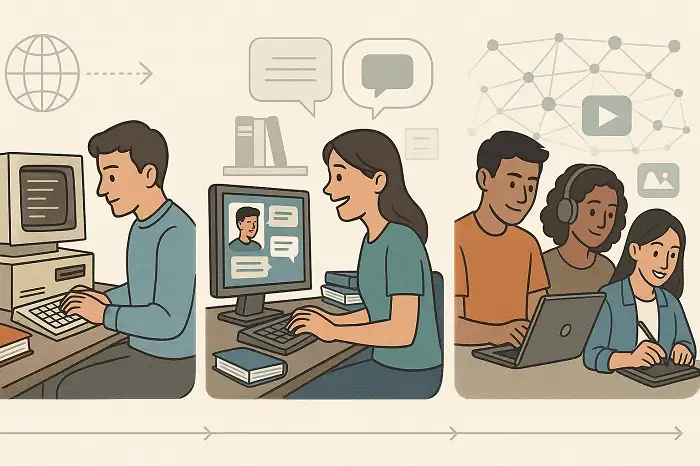
Among various benefits derived from implementing CALL-oriented programs, according to Chapelle and Jamieson (1986), individualization, record keeping and answer judging are of primary importance. Individualization in CALL refers to the fact that the computer enables L2 learners to work alone and at their own pace (AbuSeileek, 2007; Chapelle & Jamieson, 1986; Leahy, 2008; Warschauer, 1996). In the light of individualized instruction, poor students can attain additional practice outside of the classroom. Therefore, the teacher does not need to slow down the pace of instruction for the whole class. On the other hand, individualization can allow the teacher to maintain the interest of good students by providing them with advanced materials.
All the data that is collected and analyzed in interaction between the student and computer can be collected, stored and processed in depth, something that is technically referred to as record keeping. Record keeping is also beneficial for providing both the teacher and the students with the profile of L2 learners’ mastery of the materials. Furthermore, data could be collected to search for patterns in students’ learning (Chapelle & Jamieson, 1986).
Answer judging takes place after L2 learners respond to a question posed by the computer. Then the computer notifies the learner if their answer is right or wrong. Afterwards, the computer classifies students’ wrong answers to save this information as students’ records and provide them with appropriate remedial activities (Chapelle & Jamieson, 1986).
Authenticity in CALL
Since the 1980s, communicative pedagogies have stressed the significance of teaching authentic texts used by native speakers in culturally authentic contexts of use, rather than purely pedagogical and academic texts (Kramsch, A’Ness & Lam, 2000). It is believed that authentic materials and activities can be appropriately realized in CALL programs by giving L2 learners access to an unlimited database of real-life materials through hypertext, multimedia and the World Wide Web.

The utilization of computers for second/foreign language learning has made it more feasible to implement authentic assessment (Provenzo, Brett & McCloskey, 2005) because when the students are provided with this opportunity to develop a portfolio that includes their own educational activities, such as essays, comments, forums, questions, podcasts, etc. plus their corresponding responses from the teacher and the other students, they automatically take cognizance of their own sense of promotion or perhaps demotion.
Nowadays, the Internet is providing truly authentic materials for English learners all around the world (Kern, 2013). For instance, the learners can chat with native speakers. Furthermore, it is perfectly feasible to simulate target situations more realistically, thanks to social networking and Web 2.0 tools that allow students to immerse themselves in online professional communities and either access authentic materials or give teachers the means to create materials and lessons that are of practical use. Simulation programs are suggested as group learning materials (e.g., activating problem solving, discussion, role play, teamwork, etc.) which lead to authentic language use (Ng & Oliver, 1987).
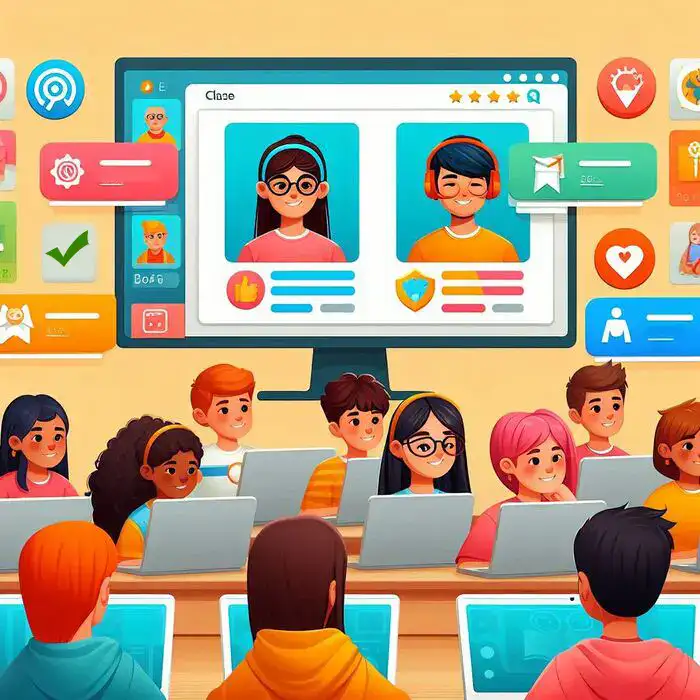
Semantic encoding and presenting stimuli ought to be on the premise of authentic materials and resources from the native community. In this regard, according to Lambropoulos, Christopoulou and Vlachos (2006), using multimedia programs, including artifacts, photographs, audio and video files, games, and so forth, could furnish the L2 learners with fairly authentic materials.
Motivation and Engagement in CALL
In a study conducted by Stevens (1991), it became clear that generally the e-learners enjoy using computers to improve their English. One of the reasons for student motivation and interest in using computers is that it is fairly easy and fast to locate information on computers in comparison to traditional ways. Another reason is that the majority of e-learners are young people who have an insatiable appetite for using technology in education.
Stanley (2013) enumerates some unique features of e-learning in conjunction with SLA that are so crucial for increasing the level of motivation in L2 learners, such as awarding badges, class weekly learning podcasts, embedded audio and video files, word games and puzzles, online classroom guests, and so forth. In a study carried out by Jones (1986), it was attempted to confirm the hypothesis that computer simulations exercises provide an excellent source of speaking practice. The results supported the hypothesis. It became clear that “it is indeed the factor of motivation which chiefly justifies the use of the computer” because “the computer keeps the discussion going by constantly providing new data” (Jones, 1986, p. 186).

Cooper (2007) conducted a study focusing on the issues that are pertinent to the use of Computer-based Learning (CBL) materials for entrepreneurship education at university level. The results elicited from interviews indicated that there was a positive correlation between a high level of motivation in the students and the personal freedom that was given to them regarding the time of learning (67%), pace of learning (51%), and the route taken through the material (66%).
According to the findings obtained in a study conducted by Beatty and Nunan (2004), in approaching a task, when the learners take an inventory of what they already know and map out appropriate strategies for approaching the task, they are better positioned to engage collaboratively in an investigation of the task and boost the level of their motivation and autonomy to develop their best to the course in comparison to the other learners who do not bother to determine their expertise. As stated by Kecskés (1986), “communication types of computer programs are intended to stimulate classroom conversation with the participation of the teacher and the students” (p. 33).

Skinner and Austin (1999) conducted a study on the impact of computer conferencing and real-time synchronous discussions in an EFL course on the level of motivation in L2 learners. The findings revealed that computer conferencing did increase the level of motivation in the L2 learners in the following three ways: (1) providing an opportunity for real communication, (2) improving personal confidence, and (3) encouraging the students to overcome writing apprehension.
Skill Integration through CALL
A lot of scholars in the field of CALL, to mention a few, (Abrams, 2001; Ewing, 2000; Levy, 1997; Warschauer, 1996) believe that CALL can provide L2 learners with ample opportunities to develop their four basic language skills which are not equally available in traditional L2 classrooms. According to Abrams (2001), computer-assisted learner-learner interactions in various social group constellations automatically inspire the learners to adopt and develop a large battery of prerequisite scholastic skills and participant roles in a more relatively learner-centered fashion in order to be successful communicators.
The L2 learners can practice all of the four skills (i.e., listening, speaking, reading and writing) naturally and interactively, thanks to computer-based multimedia, which is the combination of graphics, animation, audio, video, and other relevant elements into a single program or system (Provenzo et al., 2005; Wang & Munro, 2004) because, for instance, the learners can hold online conferences to practice oral skills. Likewise, they can correspond to each other electronically in order to practice reading and writing. The availability of multimedia in CALL has given rise to a growing interest in ways of improving L2 learners’ pronunciation skills with the help of computer-based techniques (Wang & Munro, 2004).

Metcalfe, Laurillard and Mason (1996) conducted a study on the students of a discrete-point class in which French was taught online. The primary purpose of the class was to provide the students with ample opportunities to speak French. At the end of the study, it became clear that the students lost their accuracy in writing in French with its complicated verb conjugation system. The researchers suggested that an explicit reference to written French verbs at an early stage of learning could be beneficial. They strongly advocated a holistic and integrative approach to teaching second languages in which all the four skills are practiced.
Conclusion
In conclusion, the advantages of CALL extend far beyond technological novelty. CALL supports individualized and self-paced learning, enhances motivation, and allows for authentic interaction and assessment. Through multimedia integration, learners can improve all four language skills while teachers benefit from accurate record keeping and diagnostic tools. As research consistently indicates, CALL creates a dynamic, interactive, and learner-centered environment that bridges the gap between traditional pedagogy and the digital age of education.
References
- Abrams, Z. I. (2001). Computer-mediated communication and group journals: Expanding the repertoire of participant roles. System, 29(4), 589-503. doi:10.1016/s0346-251x(01)00041-0
- AbuSeileek, A. F. (2007). Cooperative vs. individual learning of oral skills in a CALL environment. Computer Assisted Language Learning, 20(5), 493-514. doi:10.1080/09588220701746054
- Beatty, K. (2003). Computers in language classroom. In D. Nunan (Ed.), Practical English language teaching (pp. 247-266). New York, NY: McGraw Hill.
- Beatty, K., & Nunan, D. (2004). Computer-mediated collaborative learning. System, 32(2), 165-183. doi:10.1016/j.system.2003.11.006
- Chapelle, C., & Jamieson, J. (1986). Computer-assisted language earning as a predictor of success in acquiring English as a second language. TESOL Quarterly, 20(1), 27-45. doi:10.2307/3586387
- Cooper, B. (2007). Central issues in the use of computer-based materials for high volume entrepreneurship education. Active Learning in Higher Education, 8(3), 201-217. doi:10.1177/1469787407081887 212 INTERACTIVITY AND SOCIAL PRESENCE IN CALL
- Ewing, M. (2000). Conversations of Indonesian language students on computer-mediated projects: Linguistic responsibility and control. Computer Assisted Language Learning, 13(4), 333 – 356. doi:10.1076/0958-8221(200012)13:4-5;1-e;ft333
- Jones, G. (1986). Computer simulations in language teaching—The Kingdom experiment. System, 14(2), 179-186. doi:10.1016/0346-251x(86)90007-2
- Kecskés, I. (1988). Computer programs to develop both accuracy and fluency. System, 16(1), 29-35. doi:10.1016/0346-251x(88)90007-3 218 INTERACTIVITY AND SOCIAL PRESENCE IN CALL
- Kern, N. (2013). Technology-integrated English for specific purposes lessons: Real-life language, tasks, and tools for professionals. In G. Motteram (Ed.), Innovations in learning technologies for English language teaching (pp. 89-116). London, UK: British Council.
- Kramsch, C., A’Ness, F., & Lam, W. S. E. (2000). Authenticity and authorship in the computer-mediated acquisition of L2 literacy. Language Learning and Technology, 4(2), 78-104.
- Lambropoulos, N., Christopoulou, M., & Vlachos, K. (2006). Culture-based language learning objects. In P. Zaphiris & G. Zacharia (Eds.), User-centered computer aided language learning (pp. 22-44). Hershey, PA: Information Science Publishing. doi:10.4018/9781591407508.ch002
- Leahy, C. (2008). Learner activities in a collaborative CALL task. Computer Assisted Language Learning, 21(3), 253-268. doi:10.1080/09588220802090295
- Levy, M. (1997). Computer-assisted language learning: Context and contextualization. Oxford: Oxford University Press.
- Metcalfe, P., Laurillard, D., & Mason, R. (1996). French is not a language—it’s a subject: Verb learning and CALL in a mixed-ability environment. Computer Assisted Language Learning, 9(2–3), 143–160. https://doi.org/10.1080/0958822960090206
- Ng, K. L. E., & Oliver, W. P. (1987). Computer assisted language learning: An investigation on some design and implementation issues. System, 15(1), 1-17. doi:10.1016/0346-251x(87)90043-1
- Provenzo, E. F., Brett, A., & McCloskey, G. N. (2005). Computers, curriculum and cultural change: An introduction to teachers (2nd ed.). Mahwah, NJ: Lawrence Erlbaum Associates, Inc.
- Skinner, B., & Austin, R. (1999). Computer conferencing – does it motivate EFL students? ELT Journal, 53(4), 270-279. doi:10.1093/elt/53.4.270
- Stanley, G. (2013). Language learning with technology: Ideas for integrating technology in the classroom. Cambridge: Cambridge University Press.
- Stevens, V. (1991). A study of student attitudes toward CALL in a self-access student resource centre. System, 9(1), 289-299. doi:10.1016/0346-251x(91)90053-r
- Wang, X., & Munro, M. J. (2004). Computer-based training for learning English vowel contrasts. System, 32(4), 539-559. doi:10.1016/j.system.2004.09.011 229 INTERACTIVITY AND SOCIAL PRESENCE IN CALL
- Warschauer, M. (1996). Comparing face-to-face and electronic communication in the second language classroom. CALICO Journal, 13(2), 7-26.