Have to – English Flashcard for Have to for IELTS

Have to Have to (verb) to be obliged to – need to – must – should – ought to: I had to cram for my history test because I had not studied the course during the term.

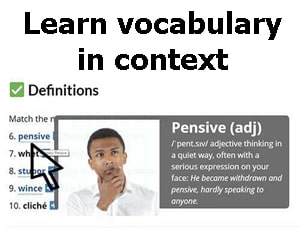
Learning English vocabulary, especially abstract and academic words, has always been a big challenge for English learners because the majority of ESL learners simply memorize words out of context. Therefore, English learners cannot score high on standardized English tests, such as IELTS, TOEFL, GRE, SAT, etc. with relatively long passages and contextualized words.
Vocabulary learning should be integrated with listening comprehension to become a more natural process. For this reason, our students can select any word, phrase, passage or the entire article in order to listen to the selected text. That is to say, LELB Society is genuinely talking to and interacting with our students.
As mentioned earlier, it’s a wrong approach to learning vocabulary out of context. At LELB Society, we provide our students with this exceptional opportunity to build up and expand academic vocabulary in real or authentic context extracted from novels, books, websites, plays, scripts of movies, poems, and the like. What’s more, our students can master advanced vocabulary in organized themes and subjects by clicking on the tags or keywords located at the bottom of each lesson. To browse our most frequently-used tags and keywords, click here and study all lessons.
Abstract words should become tangible in your mind for a longer retention. One perfect way to make abstract words tangible is to make appropriate associations between them and corresponding visual concepts, and using images and illustrations can help you achieve this goal. At LELB Society, we have illustrated thousands of advanced English vocabulary found in best-selling vocabulary books, such as 504 Absolutely Essential Words, 1100 Words You Need to Know and 601 Words You Need to Know to Pass Your Exam.
The images and illustrations are accessible only to our students or members.
Have to Have to (verb) to be obliged to – need to – must – should – ought to: I had to cram for my history test because I had not studied the course during the term.

For a time For a time (adv) for a short time – for a while – for a moment: For a time, I was starting to believe her. Then I realized she couldn’t be right. Antonyms always

Impress Impress (verb) /ɪmˈpres/ to make someone like, respect or admire you because of your appearance, performance or what you say or do – amaze: I was deeply impressed by his good performance at the piano. Parts of Speech Adjective: impressive Adverb: impressively Noun: impression Antonyms disappoint, neglect

Embryonic Embryonic (adj) /ˌem.briˈɒn.ɪk/ US /-ˈɑː.nɪk/ 1. relating to an embryo 2. starting to grow – emerging – developing: Our advancement in this new discipline is just in its embryonic stage. Parts of Speech Noun: embryo Adverb: embryonically Noun: embryology Noun: embryologist

Timid Timid (adj) /ˈtɪm.ɪd/ showing a lack of courage, confidence and assurance – shy – nervous – fearful: Being a timid student, she found it frightening to give a lecture in front of her classmates. Parts of Speech Noun: timidity Adverb: timidly Antonyms bold, brave

Metaphysics Metaphysics (noun) /ˌmet.əˈfɪz.ɪks/ US /ˌmeţ-/ the branch of philosophy in connection with the existence, knowledge, reality and the like – philosophy of being: I have an insatiable desire to learn about metaphysics and abstract concepts in life. Parts of Speech Adjective: metaphysical Adverb: metaphysically

Athlete Athlete (noun) /ˈæθ.liːt/ someone who is a professional in a field of sport and attends organized competitive races and games – sportsperson: Having practiced incessantly for 3 years, he eventually became a marathon athlete. Parts of Speech Adjective: athletic Adverb: athletically Noun: athleticism Noun: athletics

Competitor Competitor (noun) /kəmˈpet.ɪ.təʳ/ US /-ˈpeţ.ɪ.ţɚ/ an animal, person, organization, team, etc. that competes against each other – opponent – contestant: Do not underestimate your competitors in the tournament. Parts of Speech Verb: compete Noun: competition Noun: competitiveness Adjective: competitive Adverb: competitively Antonyms ally, supporter

Intense Intense (adj) /ɪnˈtents/ 1. (of a feeling, activity, etc.) having a very strong and penetrating effect – severe – extreme: intense hostility / competition / dislike 2. (of people) very serious with strong emotions – passionate: an intense teenage boy Parts of Speech Adverb: intensely Verb: intensify Noun: intensification Noun: intensity Noun: intensifier Antonyms …

Anxiety Anxiety (noun) /æŋˈzaɪ.ə.ti/ US /-ţi/ 1. the psychological state of being worried and frightened for a continuous period of time – nervousness: His intense anxiety was the reason why he saw a psychologist. 2. willingness to do something – eagerness: I was suddenly filled with the anxiety to approach her and propose to her …