Table of Contents
Explore the class activities used in this PhD research on online language learning, interactivity, and social presence. This chapter of the methodology examines four key activities: argue for/against, photo scanning, collaborative writing, and round table discussions. It explains how synchronous and asynchronous communication, peer assessment, learner autonomy, critical thinking, and negotiation of meaning were integrated into a computer-assisted language learning (CALL) program to promote collaborative knowledge construction and meaningful participation in a private online learning community.
Class Activities
In this study, several activities were designed and implemented by the researcher with the aim of enhancing the level of interactivity and social presence among the participants. A detailed account of these class activities will be provided in the following paragraphs. It is important to note that among all our class activities, round table was centralized by the researcher because it could have the potential for growing social presence in our language learning blog.
Argue for/against Activity
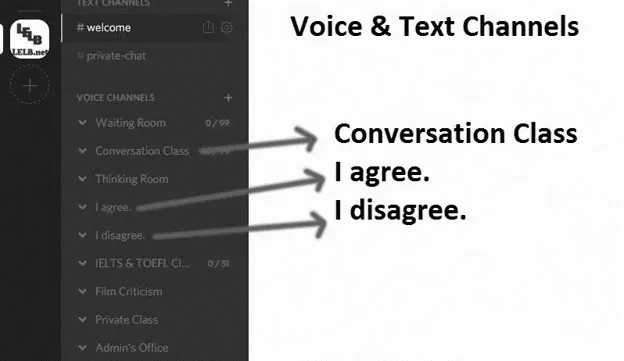
In our argue for/against activity, the participants were supposed to argue either for or against a challenging question or statement vis-à-vis the specified topic in each session and correspondingly enter either I agree or I disagree voice channel on Discord. The participants were given approximately two minutes to brainstorm over their claims in collaboration with their partners in their own voice channels. They were supposed to come up with as many cogent reasons as they could to convince the opposing group that they were right in the argument.

After two minutes of collaborative brainstorming, the participants would come back to the English Conversation voice channel on Discord to have a heated argument with each other, as illustrated in Figure 1. In this group-based activity, which was implemented in the second phase of the investigation, the researcher intentionally did not take a firm position to the statement unless all of the participants unanimously entered one specific sub-voice channel. In this case, to play devil’s advocate, he, regardless of his true personal beliefs, entered the opposing sub-voice channel.
This relatively neutral position of the researcher in our argue for/against activity was adopted from Palloff and Pratt’s (2003) tips on boosting critical thinking and reflectivity among virtual students, according to which the instructor is advised to act as a facilitator, and the students should be encouraged to take charge of the learning process themselves so that the participants could perceive that “knowledge creation occurs mutually and collaboratively online, leading to increasing critical thinking abilities” (Palloff & Pratt, 2003, p. 7).
The argue for/against activity was based on small-group tasks, which according to Palloff and Pratt (2005), encourage learners to assume active and responsive roles in collaboration with their peers or group members in response to a topic or theme. In addition, applying small-group projects in online courses can “demand self-assessment on the part of individuals to determine the quality of their contributions to the group” (Palloff & Pratt, 2005, p. 78). Moreover, dividing the class into small groups can stimulate the students to experience more enjoyable and inspiring discussions (Chapelle & Jamieson, 2008).
Photo Scanning Activity
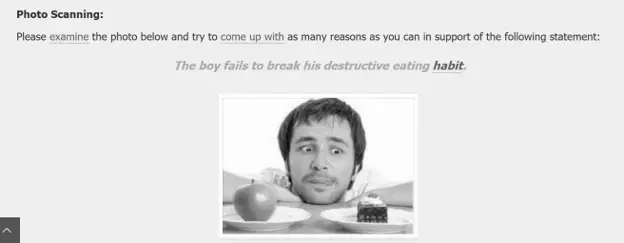
The Argue for/against activity was followed by another one, which was called photo scanning. As its name indicates, in this activity, the participants were supposed to scan a photo about the theme of the class and attempt to come up with as many evidentiary reasons as they could to bear out a claim that was stated in the caption of the photo on the corresponding post. Photo scanning – as a WebQuest-based activity – according to Chapelle and Jamieson (2008), required the participants to use the computer to solve a problem both individually and in partnership with each other. Figure 2 is intended to cast light on what was actually happening in our photo scanning activity. In this session, we focused on the topic of habits. As illustrated below, the boy has two food alternatives (an apple and a piece of cake). The statement in the photo scanning activity of this session on habits was The boy fails to break his destructive eating habits.
Collaborative Writing Activity
In our collaborative writing activity, which was implemented in the second phase of the investigation in a paid class, the participants as the essayists were expected to compose an argumentative essay interactively by asynchronously referring to a post created by the researcher with a topic on top and a comment form at the bottom.
In this activity, the first essayist would develop the first paragraph as the introductory one, and the subsequent essayists were expected to complete the entire essay by first reviewing the previous paragraphs, and then developing their own paragraphs. The participants could also perform peer-assessment both linguistically and semantically or ask for clarification through replying to the previous paragraphs in a nested or threaded fashion, which was quite distinctive from the main paragraphs as comments.
Round Table Activity
The core of our English conversation class was an activity labeled round table. The rationale for calling this activity round table was that the participants were expected to raise an appropriate question about the topic of the next session determined by themselves through voting on Fridays, and place it in the comment form at the bottom of the corresponding post that was created by the researcher with regard to the topic.
Then the participants had plenty of time (from Friday to Wednesday) to refer to the specified comment form asynchronously, posing questions to each other, editing their own questions (self-assessment), replying to or voting for/against the other participants’ questions (peer-assessment), receiving feedback from the researcher (teacher-assessment), and preparing themselves for giving appropriate answers to each individual question synchronously in the class as the poser of questions would determine to whom each question should refer unpredictably. In other words, the participants were free to choose who should answer their questions among their existing classmates in each session.
Among various activities in our round tables, raising one proper question in conjunction with the topic being discussed and replying to one of the questions developed by the other participants asynchronously in our comment forms (Stanley, 2013) were obligatory assignments. The deadline for completing the assignments was Tuesday, 9:00 pm, i.e. 24 hours before our main discussions in the form of voice conferences on Skype and Discord. The dominant type of questions that the participants, including the researcher, left in our comment forms was open-ended.
Palloff and Pratt (2005) maintain that “open-ended questions can stimulate interaction in an online discussion” (p. 70) as this type of questions can encourage the learners to examine almost any aspect of a question, and in so doing, the online course would become more dynamic by nature. In this regard, Lee (2004) proposes that open-ended questions in a mutual exchange of ideas among the students are quite a meaningful practice because the learners are encouraged to use specific vocabulary and structures to engage in the conversation successfully.
References
- Chapelle, C. A., & Jamieson, J. (2008). Tips for teaching with CALL: Practical approaches to computer-assisted language learning. New York, NY: Pearson-Longman. 211 INTERACTIVITY AND SOCIAL PRESENCE IN CALL
- Lee, L. (2004). Learners’ perspectives on networked collaborative interaction with native speakers of Spanish in the US. Language Learning and Technology, 8(1), 83-100. 220 INTERACTIVITY AND SOCIAL PRESENCE IN CALL
- Palloff, R. M., & Pratt, K. (2003). The virtual student: A profile and guide to working with online learners. San Francisco, CA: Jossey-Bass.
- Palloff, R. M., & Pratt, K. (2005). Collaborating online: Learning together in community. San Francisco, CA: Jossey-Bass.
- Stanley, G. (2013). Language learning with technology: Ideas for integrating technology in the classroom. Cambridge: Cambridge University Press.