Class Activities for Online Language Learning and Social Presence

Class Activities for Online Language Learning and Social Presence
Explore the class activities used in this PhD research on online language learning, interactivity, and social presence. This chapter of the methodology examines four key activities: argue for/against, photo scanning, collaborative writing, and round table discussions. It explains how synchronous and asynchronous communication, peer assessment, learner autonomy, critical thinking, and negotiation of meaning were integrated …


Qualitative Data Collection: Interviews, Observation, and Questionnaires

Qualitative Data Collection: Interviews, Observation, and Questionnaires

This article examines three qualitative data collection instruments used in an online language learning study: semi-structured interviews, participant observation, and open-ended questionnaires. It explains how interviews supported grounded theory and the constant comparative method, how observations and audio recordings contributed to triangulation, and how open-ended questionnaires provided richer participant responses. The discussion also covers individual …

Qualitative Research Methodology in Online English Learning

Qualitative Research Methodology in Online English Learning

This article presents the methodology of a qualitative study investigating social presence and interactivity in online English learning. It discusses the rationale for adopting qualitative research, participant selection, sampling strategies, instrumentation, and the use of grounded theory. The study examines iteration, saturation, criterion sampling, snowball sampling, semi-structured interviews, memo-writing, constant comparative analysis, and the researcher’s …

Criticisms and Challenges of Computer-Assisted Language Learning

Criticisms and Challenges of Computer-Assisted Language Learning

Computer-Assisted Language Learning (CALL) offers significant opportunities for language education, but it also faces important pedagogical, technical, methodological, and learner-related challenges. This article examines major criticisms of CALL, including the novelty effect, overemphasis on technology, inadequate learner-centeredness, limited attention to learning styles, right-to-left language challenges, material development issues, and insufficient collaboration and integration. It also …

Collaboration, Immediacy, Belonging, and CBI in CALL

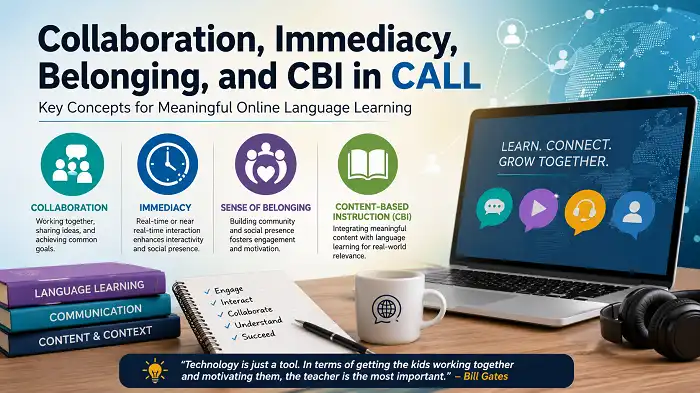
Collaboration, Immediacy, Belonging, and CBI in CALL

This article explores four influential concepts in Computer-Assisted Language Learning (CALL): collaboration, immediacy, sense of belonging, and Content-Based Instruction (CBI). Drawing on established research, it explains how these concepts contribute to learner interaction, social presence, motivation, and language development in online environments. The discussion also highlights practical principles for implementing CBI and fostering meaningful communication …

LELB Society Turns 11: New Learning Services & Major Updates

LELB Society Turns 11: New Learning Services & Major Updates

Celebrate the 11th anniversary of LELB Society on July 6th 2026 as we unveil exciting educational updates, innovative learning services, and a stronger focus on asynchronous learning. Discover new programs such as LELB Talks, asynchronous webinars, and the Golden Summer course (تابستان طلایی) for children. This special milestone also coincides with the birthday of Dr. …

LELB Talks: Asynchronous Voice & Text Learning Sessions

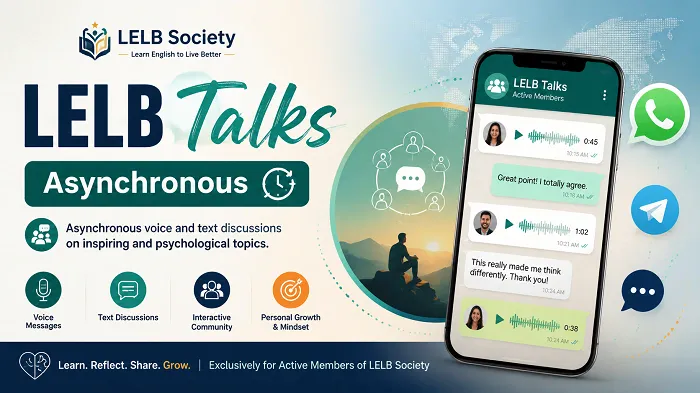
LELB Talks: Asynchronous Voice & Text Learning Sessions

LELB Talks is an asynchronous learning and discussion format designed for active members of LELB Society. Participants engage in interactive voice and text-based conversations on messaging platforms such as WhatsApp or Telegram. The sessions focus on psychological and personal development topics, including confidence building, emotional intelligence, and overcoming fear. Discussions are ongoing and flexible in …

Social Presence and Collaborative Learning in Online Education

Social Presence and Collaborative Learning in Online Education

This article explores the role of social presence, collaboration, and interactivity in online learning environments, particularly in CALL and CMC-based language education. Drawing on major studies and theoretical frameworks, it examines how teacher presence, group interaction, online communication, and learner engagement contribute to student satisfaction, community building, and effective virtual learning experiences. The article also …

Social Presence and Student Interaction in Online Language Learning

Social Presence and Student Interaction in Online Language Learning

Explore the critical role of social presence and student interaction in online language learning environments. This article delves into how computer-mediated communication (CMC) reshapes participation, examining linguistic complexity, negotiation patterns, and the shift toward more balanced classroom discourse. It contrasts early theories that emphasized communication media with modern views that prioritize participant behavior in developing …

LELB Society in 2026: Strategy, Roadmap, and Future Plans

As we enter 2026, LELB Society continues its long-term commitment to asynchronous and flipped learning, empowering learners to study anytime, anywhere, and at their own pace. This year, our roadmap expands beyond language education with new video-based categories, including learning the electronic keyboard, French, and a growing collection of motivational and success-oriented materials. While staying …