Social Presence and Collaborative Learning in Online Education

Social Presence and Collaborative Learning in Online Education

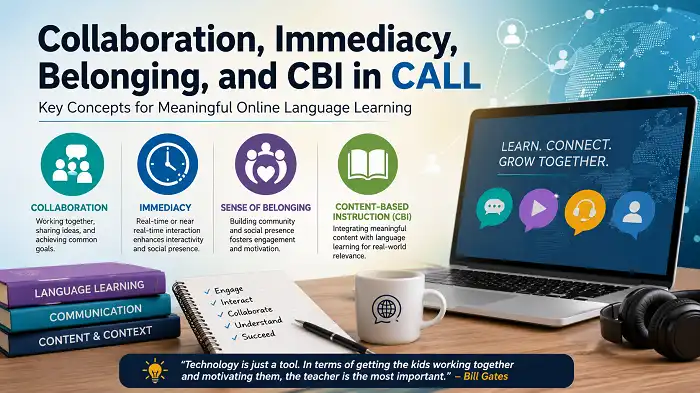
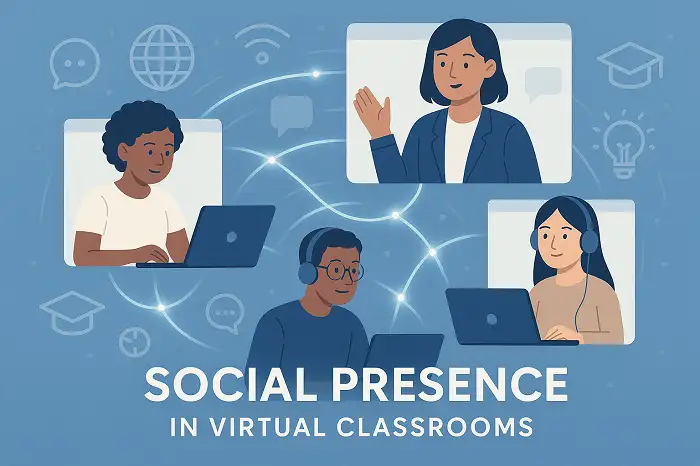
This article explores the role of social presence, collaboration, and interactivity in online learning environments, particularly in CALL and CMC-based language education. Drawing on major studies and theoretical frameworks, it examines how teacher presence, group interaction, online communication, and learner engagement contribute to student satisfaction, community building, and effective virtual learning experiences. The article also …

Social Presence and Student Interaction in Online Language Learning

Social Presence and Student Interaction in Online Language Learning

Explore the critical role of social presence and student interaction in online language learning environments. This article delves into how computer-mediated communication (CMC) reshapes participation, examining linguistic complexity, negotiation patterns, and the shift toward more balanced classroom discourse. It contrasts early theories that emphasized communication media with modern views that prioritize participant behavior in developing …

ICT and Synchronous Communication in Language Learning

ICT and Synchronous Communication in Language Learning

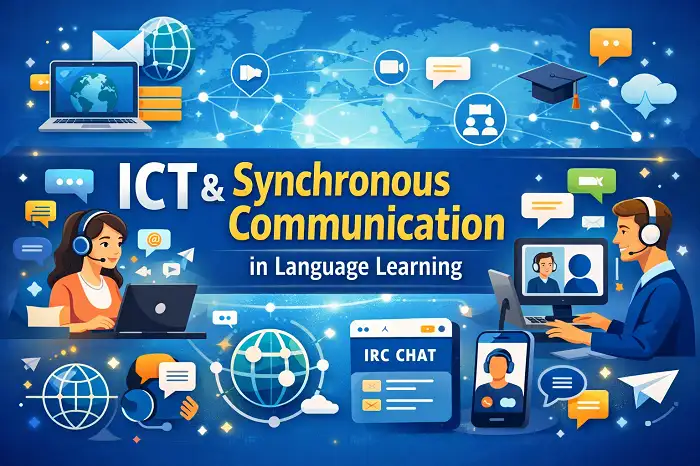
Information and Communication Technology (ICT) has transformed language learning by providing access to authentic materials, interactive tools, and online communication platforms. From general-purpose software to advanced Computer-Assisted Language Learning (CALL) programs, ICT offers learners and teachers opportunities to improve language skills effectively. Synchronous computer-mediated communication (SCMC) and instant messaging platforms allow real-time interaction, enhancing collaboration, …

History and Evolution of Computer-Assisted Language Learning (CALL)

History and Evolution of Computer-Assisted Language Learning (CALL)

Computer-Assisted Language Learning (CALL) has revolutionized language education since its emergence in the 1960s. This comprehensive review explores the evolution of CALL across three major stages — behavioristic, communicative, and integrative — highlighting how technology has transformed teaching and learning practices in second or foreign language education. From grammar drills and syntax exercises to interactive …

The Significance of Social Presence in Integrative CALL

The Significance of Social Presence in Integrative CALL

The rapid growth of online education has transformed the way languages are taught and learned worldwide. With the continuous advancement of technology and the increasing reliance on digital platforms, understanding the role of social presence in computer-assisted language learning (CALL) has become crucial. This article highlights the significance of fostering social and communicative interaction in …

Key Terms in CALL, CMC, and Online Language Learning

Understanding the key terms in Computer-Assisted Language Learning (CALL) and Computer-Mediated Communication (CMC) is essential for exploring how technology enhances second language education. This article defines crucial concepts such as asynchronous and synchronous CMC, integrative CALL, interactivity, social presence, and peer assessment. By clarifying these foundational terms, readers gain deeper insights into the role of …

Research Questions and Hypotheses on Social Presence in CALL Programs

Research Questions and Hypotheses on Social Presence in CALL Programs

This study explores how Computer-Assisted Language Learning (CALL) can foster stronger social presence, collaboration, and engagement in online English classes. By examining teacher–student interaction, assessment methods, negotiation of meaning, and Content-Based Instruction (CBI), the research identifies strategies for building interactive and supportive learning communities. The proposed research questions and hypotheses aim to highlight the most …

Can You Be Friends with AI? Pros and Cons Explained

Can humans truly form friendships with artificial intelligence? As AI becomes more advanced and integrated into daily life, many people wonder if emotional bonds with machines are possible—or even healthy. While AI companions can provide comfort, support, and endless availability, they also raise concerns about authenticity, dependency, and human connection. This article explores the pros …

Building Social Presence in CALL for Online English Learning

Building Social Presence in CALL for Online English Learning

Computer-Assisted Language Learning (CALL) has gained recognition as a key component of English education in the digital age, yet its implementation still faces important challenges. Success in online learning requires more than just advanced technology; it depends on fostering social presence, collaboration, and interaction among learners and teachers. This article examines how peer-assessment, negotiation of …

Scaffolding and Collaborative Learning at LELB Society

Scaffolding and Collaborative Learning at LELB Society

At LELB Society, we implement scaffolding in asynchronous learning through interactive activities like our round table forum, where students actively engage in knowledge construction. Drawing on Vygotsky’s zone of proximal development (ZPD), our teachers foster social presence in online venues by replying directly to student comments with form-focused instruction and corrective feedback. This method encourages …

Register