Table of Contents
Negotiation of meaning plays a central role in second language learning by promoting comprehension, interaction, feedback, pushed output, and noticing. This article explores how negotiation supports SLA in educational settings and examines the role of computer-mediated communication (CMC), online discussions, synchronous tasks, and CALL in facilitating meaningful interaction. Drawing on research by Long, Pica, Warschauer, Blake, Smith, Chapelle, and others, it discusses how online environments can expand opportunities for language learners to negotiate meaning and develop more target-like output.
Video of Negotiation of Meaning

Negotiation of Meaning
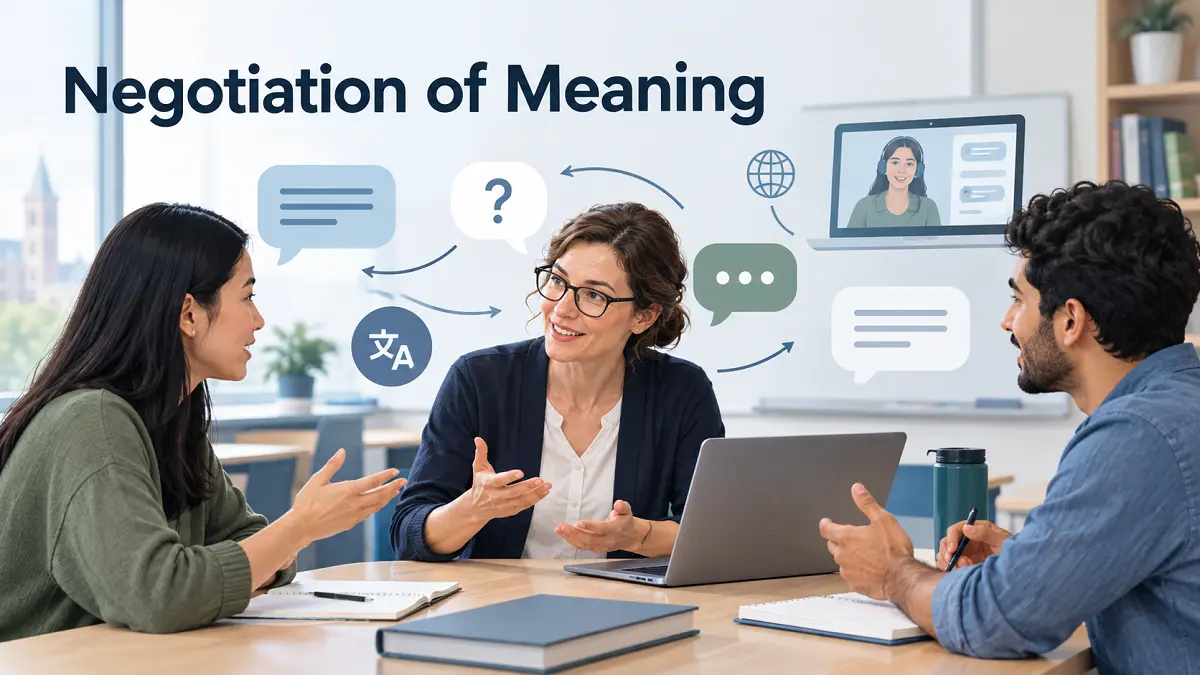
On the significance of discourse and negotiation in educational settings, Edwards and Mercer (1987) propose “it is essentially in the discourse between teacher and students that education is done or fails to be done” (p. 110). If students are given ample opportunities to play active roles as negotiators with their teacher with the intention of seeking clarification and unfamiliar words and structures, negotiation does assist comprehension (Pica, 1991). Comprehensible input is not sufficient for successful second language acquisition. In fact, it is important for non-native speakers to achieve more target-like output (Pica, 1988/1991).
Negotiation Strategies in Communication

During inter-ethnic communication, some special discourse management techniques must be employed as an attempt to simplify the discourse and avoid communication problems (Smith, 2003). Long (1983) mentions a number of what he calls strategies for avoiding communicative breakdown, including limiting the amount and type of information conveyed, the use of questions, employing a here and now orientation, using confirmation checks, and using self-repetition. If teachers can guide students through getting into the right kinds of conversations, online conversations and discussions can extend the opportunities beyond what the learners can do in the traditional classrooms (Chapelle & Jamieson, 2008).
Computer-Mediated Communication and Negotiation of Meaning
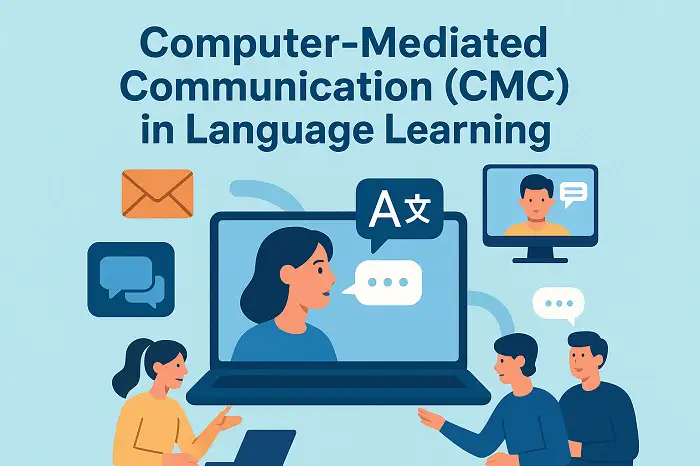
According to Sullivan (1993, as cited in DiGiovanni & Nagaswami, 2001), “CALL provides a forum for social interaction, collaboration, negotiation of meaning and dissension. In addition, transcripts of the real-time discussions can be stored easily as a shared accessible resource for research and reference” (p. 34). However, online negotiations require the students to engage in a new mode of communication that involves other skills, such as use of hardware and software, familiarity with jargon associated with hardware and software, and the composing and typing of messages, and lacking keyboarding skills only handicaps online negotiators (DiGiovanni & Nagaswami, 2001).
Interactionist Perspectives on L2 Learning

Online Interaction through CALL
From an interactionist perspective on L2 learning, according to Smith (2004), CMC-based activities are relevant to and facilitative of the processes that are believed to be beneficial to SLA. For instance, they can furnish the learners with rich input, promote pushed output, provide abundant feedback, and enhance noticing. Furthermore, as stated by Warschauer (1996), L2 learners regard CMC as being less threatening in comparison to face-to-face communication, which is often the reason for an increased willingness to take risks and normalize the stress level.
Online Tasks and Negotiation of Meaning

In a study conducted by Blake (2000), 50 intermediate L2 Spanish learners were asked to carry out networked discussions in pairs during their lab time using a synchronous chat program, Remote Technical Assistance (RTA), which recorded all textual entries. Each dyad implemented a series of online tasks that could be described as jigsaw, information-gap or decision-making. The findings revealed that jigsaw tasks appeared to be more effective in promoting optimum negotiation of meaning. In addition, the results suggested that CMC can provide the alleged benefits ascribed to the Interaction Hypothesis. According to Hegelheimer and Chapelle (2000), interactionist theories claim that linguistic input that is received through CALL ought to become intake so as to be acquired by the learner. That is to say, this input must be both syntactically and semantically comprehended.
References
- Blake, R. (2000). Computer mediated communication: A window on L2 Spanish interlanguage. Language Learning & Technology, 4(1), 120-136.
- Chapelle, C. A., & Jamieson, J. (2008). Tips for teaching with CALL: Practical approaches to computer-assisted language learning. New York, NY: Pearson-Longman. 211 INTERACTIVITY AND SOCIAL PRESENCE IN CALL
- DiGiovanni, E., & Nagaswami, G. (2001). Online peer review: An alternative to face-to-face? ELT Journal, 55(3), 263-272. doi:10.1093/elt/55.3.263 213 INTERACTIVITY AND SOCIAL PRESENCE IN CALL
- Edwards. D., & Mercer, N. (1987). Common knowledge: The development of understanding in the classroom. London, UK: Methuen.
- Hegelheimer, V., & Chapelle, C. A. (2000). Methodological issues in research on learner-computer interactions in CALL. Language Learning & Teaching, 4(1), 41-59.
- Long, M. (1983). Native speaker/non-native speaker conversation and the negotiation of comprehensible input. Applied Linguistics, 4(2), 126-141. doi:10.1093/applin/4.2.126
- Pica, T. (1991). Classroom interaction, negotiation, and comprehension: Redefining relationships. System, 19(4), 437-452. doi:10.1016/0346-251x(91)90024-j
- Smith, B. (2003). The use of communication strategies in computer-mediated communication. System, 31, 29-53. doi:10.1016/s0346-251x(02)00072-6
- Smith, B. (2004). Computer-mediated negotiated interaction and lexical acquisition. Studies in Second Language Acquisition, 26(3), 365-398. doi:10.1017/s027226310426301x
- Warschauer, M. (1996). Comparing face-to-face and electronic communication in the second language classroom. CALICO Journal, 13(2), 7-26.