Table of Contents
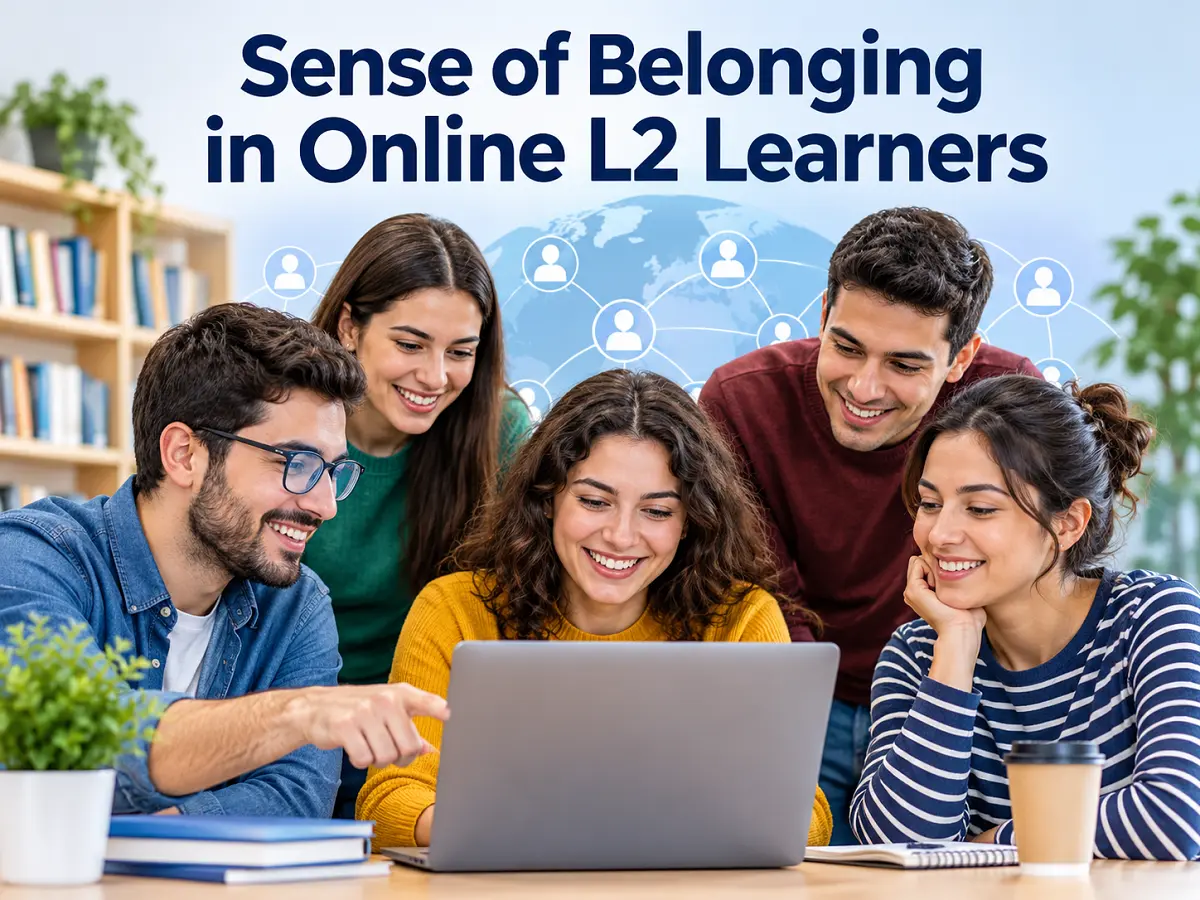
This section of Chapter 4 of my PhD thesis explores how to create a strong sense of belonging among L2 learners in online learning communities. Drawing on students’ feedback and research findings, it examines the role of academic satisfaction, social interaction, collaborative activities, learner autonomy, and shared goals in fostering lasting engagement, a sense of community, and meaningful participation in virtual language classes.
Results of Q3: Creating a Sense of Belonging in the Learners
Students’ sense of belonging refers to a raised level of reflection in them that can support active and collaborative construction of knowledge through social negotiation when the students can feel that they are related to each other and have a shared set of goals (Gunawardena, 1995). Bearing this definition in mind, the researcher noticed that upon taking our conversation class incessantly, some participants were imperceptibly offering practical propositions on making some improvement to the course.
More to the point, in the majority of cases, the students offered their valuable suggestions voluntarily. That is to say, the teacher did not solicit them for feedback, except our call for feedback sections. For instance, F. Rezanejad, wisely proposed that we could create a special comment in our comment form in each session in which the participants were encouraged to share their findings and experiences, e.g. relevant inspiring quotations vis-à-vis the topic being discussed in the form of replies as an optional activity, which was unanimously approved by the participants, including the teacher.

Additionally, F. Rezanejad called for some modification to our round tables to make them more dynamic. She contended that it would be better if other students could voluntarily respond to a question not directly pointed to them by the question poser, as it was not the case. Likewise, S. Daliri, in one of our call for feedback sessions, requested that we could spend more time on our argue for/against activity, which, according to him, was a genuinely interactive and challenging task that could help the participants to practice brainstorming and get involved in problem-solving activities. In another interview, V. Kalhor requested the researcher to direct the attention of the class to the most important questions, replies, or threads in our discussion forums and comment forms as the content of the course due to the shortage of time.
In another interview, Fatemeh advised the researcher to consider some points about Search Engine Optimization (SEO) to increase the number of visitors and improve the rank of our website as if it was really hers. She recommended that the researcher make the website bilingual, use a language switcher plugin, and develop some content for intermediate, pre-intermediate and even elementary students, as well both in English and Persian in order to increase the traffic of the website. Moreover, she said that she would invite her friends to our conversation class, and later on, some new students like V. Kalhor joined us, thanks to Fatemeh.
F. Rezanejad had developed such a strong sense of belonging to our online community and virtual classes that she incessantly participated in all of our virtual classes, although she had a one-year-old son. In fact, as stated by herself, she used to ask someone to take care of her infant for her during the class in both our free classes, and later on, paid classes, which were all held from 9:00 to 10:00 pm, when generally new mothers prefer to spend time with their babies.
On the other hand, some participants (e.g., S. Daliri and S. Ghomi) had developed such a strong sense of belonging to the course and our online community that they would ask the researcher what would happen to the course after defending his Ph.D. dissertation project. This sense of belonging developed in the majority of the participants was so strong that inspired Mana, one of our participants from Zanjan who did not attend our online courses but was extremely active in our discussion forums, to write a piece of poem on our community and publish it in our discussion forums, which can be accessed in Appendix I.

Generating a sense of belonging in the L2 learners is by no means an easy task. According to Gunawardena (1995) and Picciano (2002), a sense of satisfaction is a sine quo non for a sense of belonging in the learners. This point was confirmed repeatedly in our call for feedback sessions by, for instance, S. Daliri and T. Ghanooni. T. Ghanooni, who had been following our virtual classes for more than a year, stated that the possibility of engaging in a variety of interesting and exciting activities and tasks, particularly in the second phase of the investigation, was academically satisfying to her, thus strengthening her sense of belonging. In this regard, S. Daliri, in another group interview, mentioned that he never experienced even one single monotonous session in his lengthy pursuit of our virtual classes.
Concerning the influence of a sense of academic satisfaction on the realization of a sense of belonging in the learners, it was observed that the lengthy process of creating and uploading podcasts or vodcasts/podclips (Dudeney & Hockly, 2007) belonging to our round tables with the help of the participants for further and future assessment, which is also referred to as coursecasting (Dudeney & Hockly, 2007) was moderately effective in establishing and strengthening a sense of belonging in the participants because as reflected in some open-ended questionnaires completed by A. Ahadzadeh, Bashir, H. Rezaei and M. Rostampour, they could listen to their own negotiations and examine their own interactive and asynchronous activities vis-à-vis each round table.
Regarding the rationale behind her sense of belonging to our community, F. Rezanejad specified in her questionnaire that our round tables were helpful for her to learn English practically in interaction with her peers as they were supposed to pose questions to each other, reply to each other asynchronously, and prepare themselves for upcoming oral discussions in our synchronous classes based on their own social contributions and findings. Moreover, in a session that we were talking about self-discipline, F. Rezanejad was curious to know whether she could share her future findings and ideas asynchronously in the form of comments on that post and topic (self-disciple) after the class was over or not, whose answer was a big yes, implying that her sense of belonging and satisfaction had inspired her to develop her very best to the course, as it was really the case.
Another factor that led to the academically satisfying experience of the participants, and consequently consolidated a sense of belonging in them was the implementation of skill integration in our CALL program. This point was confirmed by some participants (e.g., S. Daliri; S. Ghomi; T. Ghanooni) in our questionnaire. According to T. Ghanooni, practicing the four skills interactively and naturally had made our virtual classes “so special”. Furthermore, some participants, for instance, Amir and Niaz from Malaysia, would voluntarily stay up so late at night to follow our course because our classes were held at around 2:00 am in their time zone, which was such an unearthly hour. In our interviews, they acknowledged that they had such a strong sense of belonging to the course that they were ready to make that sacrifice.
Additionally, irrespective of the current study, in our semi-structured interviews, a great deal of the participants, particularly those who were employed and did not have enough time to attend face-to-face classes (e.g., Azadeh; F. Rezanejad; S. Daliri; S. Nasiri; S. Ghomi) would frequently refer to some unique advantages of attending virtual classes (not necessarily our classes), including saving a substantial amount of time, energy and money. To be more specific, S. Nasiri affirmed that she could sit in her room or any other relaxed place, attending our virtual classes without the necessity of spending so much time on the way.
Later on, in the same group interview, she continued, “I personally believe that it is not necessary to attend traditional classes. If you are wise enough, you can get whatever you need in virtual classes”. On the other hand, Azadeh mentioned that her experience of attending our virtual classes for the first time in her life convinced her that appropriate virtual classes could be cost-effective to a noticeable extent because, in her case, she could successfully control and reduce the total expenditure on course registration, purchasing coursebooks and reference books, transportation costs while commuting between home and language institutes, and so forth. It is important to note that the above-mentioned advantages of attending any effective virtual language class were raised by the participants in our interviews in response to the strong relationship between the students’ academic satisfaction and their willingness to show their belonging and affiliation to their online learning community.
Discussion of Q3: Creating a Sense of Belonging in the Learners
When the L2 learners are given this personal freedom to use the appropriate time, pace and procedure for learning that work for them (individualization, especially through asynchronous CMC), the level of their motivation and satisfaction increases respectively. This point is also in accord with Cooper’s (2007) findings on the relationship between using computers for educational purposes and the learners’ developed perspectives and attitudes.
For L2 learners to develop a sense of belonging to their online learning community, first it must be attempted to develop a sense of satisfaction in them, for the former without the latter could not last long. All of the 42 participants of the study (Appendix E) unanimously stated that the high quality of our online classes in terms of selecting interesting topics, a variety of exciting activities, focusing on best-selling coursebooks (e.g., 1100 Words You Need to Know and English Grammar in Use), practicing all the four skills interactively (skill integration), the teacher’s special attention to correct the learners’ mispronunciations in our oral discussions and their grammar mistakes in our writing tasks (when peer-assessment was not carried out), and so forth were among the most satisfying features of our online community, implying that social presence and interactivity are merely a simple but at the same time indispensable instrument for the ultimate goal of creating an effective learning community.
Fortunately, there always exist some advantages that are unique to distance learning, including saving a considerable amount of time, money and energy, which can make the process of learning more satisfying for language learners. The L2 learners can change their rooms to ideal language classes that are generally more cost-effective than face-to-face classes. They do not need to waste a great deal of time, commuting between home and classes in the congested traffic while carrying cumbersome fat dictionaries and other printed materials. As a matter of fact, learning second/foreign languages, especially English, in the twenty first century could be both digitalized and globalized so that the students’ shared needs and goals could be realized.
When CALL practitioners set the social context in a way that the online community can literally be regarded as an all-in-one package to satisfy the learners needs and goals in an interactive mode, for example through the employment of thematically categorized discussion forums and boards to exchange questions and answers, giving the learners interactive assignments, such as collaborative writing tasks in which each learner composes one paragraph of an entire essay while performing peer-assessment, giving the learners this exceptional opportunity to pose challenging questions to each other in the form of comments in preparation for inspiring and interesting discussions synchronously, then the fulfillment of a sense of community and belonging in the L2 learners is guaranteed.
Classified discussion forums for various purposes, for instance exchanging English questions and answers, English quotations, jokes, riddles, thematically categorized challenging questions in English, and so forth, can motivate the learners to satisfy their academic needs by means of growing a sense of interdependency among each other, which after a while, automatically consolidates a sense of belonging to the online learning community in the learners.
The analysis of the participants’ feedback reflected in 41 semi-structured interviews and a supplementary open-ended questionnaire unanimously confirmed this assumption that the realization of the L2 learners’ needs through fulfilling the goals that are shared among them, and establishing rapport among the learners carry more weight in comparison to the other two elements proposed by McMillan and Chavis (1986), i.e. compromising and the ability to influence the group to account for a sense of belonging and community.
Our round table activity appeared to be helpful in the realization of the learners’ needs and goals that were shared among them because, first of all, they themselves would select the challenging topics, and then, they would go through asynchronous brainstorming, problem-solving and scaffolding activities during the week in an interactive and collaborative manner to lay a solid foundation for our upcoming well-informed discussions in our synchronous voice-based classes. The very act of conducting inquiries into the informative, intellectual and interesting topics in both individualized and interactive manners taking place specifically on our comment forms and discussion boards before our classes on Skype and Discord helped the learners to develop a great sense of belonging and community. Furthermore, the last part of our round table activity, i.e. reaching for a conclusion, could also consolidate this sense of belonging in the participants because it was in this section that their one-week individualized and interactive inquiries and activities would become manifest and objective to them (i.e., realization of needs and goals that are shared among the learners).
As a matter of fact, when language learners are welcome to participate in making decisions in the process of learning (e.g., choosing the topics for discussions rather than having to accept the topics), assume active roles and responsibilities (e.g., creating the content of the course in the form of asynchronous questions and answers), and so forth, the generation of a sense of community and belonging would be imminent. In this study, the researcher, as a participant observer, tried to employ Zone of Proximal Development (ZPD) in the online classes with the intention of increasing student interaction. It became clear that the presence of a more capable interlocutor (the researcher as the teacher) is necessary to account of ZPD through which the L2 learners develop their best to increase their academic involvement in problem solving activities (van Lier, 2004).
Moreover, when the L2 learners are notified that all of their academic and interactive activities and contributions, including their posts, comments, replies, public messages (not private messages), interactive activities in discussion forums, podcasts of their oral discussions in synchronous classes, are archived on the blog for future use and reference, they automatically deem that maximizing their well-informed and interactive involvement and contribution to the learning blog acts as a boomerang. That is to say, the more they consolidate their conscious and collaborative involvement (both synchronously and asynchronously) in the learning blog based on an excellent rapport with their peers, the more this learning community could be of practical use to them. In this inspiring atmosphere, the active members of the community voluntarily offer invaluable and well-thought feedback on improving the quality of the learning community, which more belongs to them in comparison to the teacher.
Considering one discussion forum to exchange the learners’ ideas, viewpoints and even criticism without the interference or censorship of the teacher or administrator proved to be another appropriate technique for raising the level of asynchronous communication and a sense of belonging in the partakers. In our learning blog, the researcher created an exclusive discussion board under the title of Students’ Testimonials where the students could freely express their opinions and criticism about the researcher’s methodology, our adopted tasks, topics and activities, the social context or the blog, and the like.
Our 41 semi-structured interviews under the title of call for feedback turned out to be influential in developing and enhancing the sense of belonging and community in the learners because when the L2 learners notice that their valuable and informed ideas, criticisms and suggestions are listened to, reflected upon, and implemented, especially in public and in the presence of the other students – as long as their feedback is in line with the educational criteria and purposes of any institution – the learners owe their success to the success of the learning community, which means that they voluntarily develop a sense of belonging and community to the learning blog.
It must be pointed out that the realization of a lasting sense of belonging in the learners is by no means an easy task and it does require regular consistent maintenance so that the learning community could successfully persist in its affairs in the existing stiff competition among thousands of other online educational institutions. One of the greatest impediments to creating a sense of belonging in L2 learners is a negative attitude toward the efficacy of the Internet for academic purposes, which has been internalized in some language learners. There are still many people who utilize technology to learn second/foreign languages incredulously. As a consequence, they cannot develop their best to e-learning subconsciously, let alone creating a sense of belonging to e-courses.