Table of Contents
- Video of Collaboration, Immediacy, and Belonging
- Collaboration
- Immediacy
- Sense of Belonging
- Content-Based Instruction (CBI)
- CALL and Content-Based Instruction
- Tips for Teaching Content-Based Language with CALL
- Learner Fit in CALL Materials
- The Into, Through, and Beyond Framework
- Principles for Implementing CBI
- Communication and Course Content in CMC
- Teacher Talk in Content-Based Instruction
- Challenges of Content-Based Instruction
- References
This article explores four influential concepts in Computer-Assisted Language Learning (CALL): collaboration, immediacy, sense of belonging, and Content-Based Instruction (CBI). Drawing on established research, it explains how these concepts contribute to learner interaction, social presence, motivation, and language development in online environments. The discussion also highlights practical principles for implementing CBI and fostering meaningful communication and student-centered learning in technology-enhanced language education.
Video of Collaboration, Immediacy, and Belonging

Collaboration
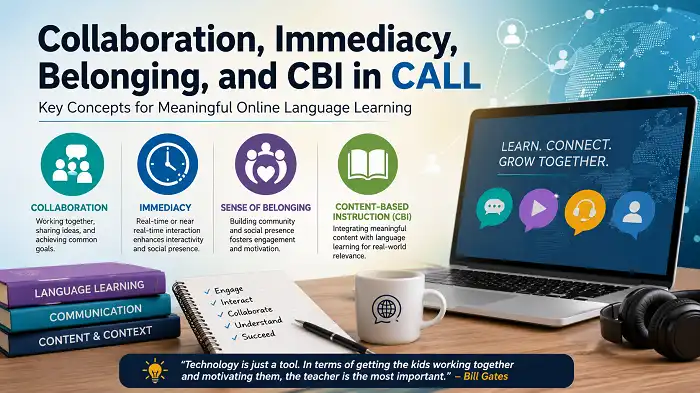
In recent approaches to education, collaborative learning is receiving a considerable amount of attention (Abrams, 2001; Beatty & Nunan, 2004; Palloff & Pratt, 2005). Beatty and Nunan (2004) define collaboration as the manifested actions a learner takes in partnership with others and can be evidenced, for instance, as an inclination to listen to others’ opinions and suggestions so that they could be discussed and integrated into further actions, namely decisions on how to complete a task.

Although cooperation and collaboration seem to be interchangeable at first glance, there actually exist slight subtle differences between the two. According to the comparison made by Beatty and Nunan (2004), cooperation only requires the learners to work together. Nonetheless, the learners are not necessarily expected to have negotiation or interaction with each other to complete academic tasks. On the other hand, when it comes to collaboration, the learners are highly expected to maximize their interaction and transcend their individualization in partnership with each other to fulfill learning tasks and projects.
Immediacy
When it comes to the immediacy factor in CMC, temporally, a distinction is made between synchronous and asynchronous communication where respectively interaction takes place in real time, and the learners are not necessarily online simultaneously (Simpson, 2002).
The concept of online immediacy affects the level of interactivity in virtual venues (Baker, 2010; Bradac, Bowers & Courtright, 1979; Cobb, 2009; Swan & Shea, 2005; Tu, 2002) because research on social presence in computer-networked communication is directly related to research on the concept of immediacy in traditional classrooms (LeFebvre & Allen, 2014; Swan & Shea, 2005).

Immediacy is referred to behaviors that are intended to decrease the psychological barriers among communicators in a discourse (Hiltz & Goldman, 2005; LeFebvre & Allen, 2014; Swan & Shea, 2005). When an immediate response is expected but not received, “a feeling of low interactivity is created” (Tu, 2002, p. 297) and the level of social presence declines in return.
Different forms of CMC have been characterized by their immediacy factors in which the most immediate form is synchronous communication, namely real-time video conferencing, IRC, and Multiple-user-domain Object Oriented (MOOs), etc. (Fotos, 2004). On the other hand, in asynchronous communication (e.g., emails, electronic bulletin boards, and the World Wide Web), learners analyze educational materials with a delay (Fotos, 2004).
Gudea (2008) believes that one of the reasons why e-learners are so fond of IRC is that, in this synchronous type of communication with a high level of immediacy, the students can quickly build relationships with each other because they can feel there is actually a real person responding to them immediately.
Sense of Belonging

Employing constructivist principles, CMC environments could be designed to provide multiple perspectives and real-world examples, encourage reflection, and support collaborative construction of knowledge through social negotiation (Gunawardena, 1995). However, such learning environments may promote collaborative learning which involves the active construction of knowledge through social negotiation only if participants can relate to one another, share a sense of community and a common goal. In other words, “the development of social presence and a sense of an online community becomes key to promoting collaborative learning and knowledge building” (Gunawardena, 1995, p. 164).
The e-teacher should take cognizance of this point that students’ perception of their use of CALL materials and Information Technology (IT) for their classes might differ from their own. As a consequence, an online thoughtful English teacher is supposed to inform their students of what they are doing and why they are doing it (Wiebe & Kabata, 2010). Their study revealed that the more the e-teacher informs the students about the actual why of taking online courses, the more the students would develop themselves to the course, for example, by logging into their accounts on language learning blogs.
Content-Based Instruction (CBI)

Content-based second language instruction is built upon the foundation that SLA could be facilitated through the medium of subject-matter content or meticulously selected themes and topics (Gaffield-Vile, 1996) because CBI could motivate the L2 learners by developing a sense of accomplishment in them through exposing them to authentic content material, i.e. not material adapted for foreign learners in the target language, which provides a departure from more traditional, linguistically-driven syllabi (Chapelle & Curtis, 2000).
In addition, applied linguists believe that language and content should not be treated discretely as language is just a communication tool for mapping content to expression (Chapelle & Jamieson, 2008). CBI is the integration of subject-matter content with language teaching aims in which the form and sequence of language presentation is determined by content material (Brinton, Snow & Wesche, 1989, as cited in Brown, 2007; Pessoa, Hendry, Donato, Tucker & Lee, 2007).
CALL and Content-Based Instruction

With regard to CBI, Yun (2011) argues for the efficacy of CALL in comparison to traditional systems of education because CALL can provide the L2 students with hypertext and hypermedia features through which the learners can easily have access to a vast amount of information in a nonlinear and interactive fashion through multiple types of resources, such as text, graphics, audio, video and animation.
Tips for Teaching Content-Based Language with CALL
Chapelle and Jamieson (2008, p. 196) propose the following tips for teaching content-based language with CALL:
- Select CALL materials with appropriate language for students’ specific-purpose needs.
- Choose CALL activities that explicitly teach field-specific language.
- Provide learners with opportunities for interaction with the computer and with other English users to practice field-specific language.
- Help learners develop their strategies for finding and using field-specific materials online.
Learner Fit in CALL Materials
Chapelle and Jamieson (2008) advise teachers to seek CALL materials with appropriate learner fit. The term learner fit refers to the level of language difficulty and the level of the content whose appropriateness guarantees students’ engagement and learning. Concerning the role of CBI in second language teaching, Pessoa et al. (2007) discuss that insufficient research exists on how this type of instruction can practically be perfected and implemented by second language teachers, although a substantial amount of professional literature theoretically argues for the myriad advantages of CBI. In this regard, Brinton and Holten (1997) propose a specific educational framework for CBI lesson planning, which they call Into, Through, and Beyond.
The Into, Through, and Beyond Framework
In this framework, through the following three stages, it is attempted to maximize students’ comprehension and mastery of content:
- Into: Students’ prior knowledge about a concept is probed and activated.
- Through: Students are confronted with the new content while making an effort to rely upon their discussions of the concept during the into stage.
- Beyond: Students demonstrate their comprehension through creatively applying their newly developed knowledge.
Principles for Implementing CBI

With the aim of increasing student autonomy, the e-teacher can adopt CBI because, according to Brinton (2003), the CBI classroom is learner rather than teacher-centered. In such classrooms, students learn through doing and actively engage in the learning process; they do not rely on the teacher to direct all learning or to be the source of all information.
In keeping with the various roles taken by learners, the CBI teacher needs to assume some specific roles. For instance, he/she may serve as the primary resource for students, particularly where issues of language or culture are concerned. The teacher is also supposed to serve as the organizer of tasks, the controller or facilitator of student-centered activities, the prompter of student responses, and the assessor of student efforts (Brinton, 2003).
The following principles have been proposed by Brinton (2003) to implement CBI in language classes:
- Instructional decisions should be based on content rather than language criteria.
- All the four skills should be naturally integrated.
- The teacher should involve the students in all of the phases of the learning process.
- The selection of content should be on the basis of students’ needs, interests, and academic goals.
- Authentic texts and tasks should be selected and implemented.
Communication and Course Content in CMC

Tella (1992) regards course content in CMC as themes and topics. In this regard, as stated by Tella (1992), the role of the communicator (writer and reader, or sender and recipient) is of primary importance because these roles complement each other, and the language user needs to adopt all of these roles through abiding by the use of initiative and free negotiable topic choice.
According to James (1996), nowadays, one of the major concerns of CALL practitioners is lack of sufficient communicative materials as the content of the course, which requires the teacher to consider how to implement appropriate exercises so as to achieve the desired interaction, rather than “simply assume that groups of learners working on a common task will automatically communicate” (James, 1996, p. 18).
Teacher Talk in Content-Based Instruction

Pessoa et al. (2007) carried out a qualitative study based on grounded theory and interviewing as the main instrument of data collection on the significance of teacher talk in CBI. In this study, two language teachers implemented two different methods for teaching English, one focusing on academic content, conversational features of interpersonal communication, and implicit error correction of language forms; and the other, focusing on manipulative practice of language form, explicit error correction by the teacher, and non-topically related exchanges with the students.
The findings indicted that the students of the former teacher performed higher in the literacy assessments because it was clarified that the implementation of classroom discourse features and higher student performance are technically interrelated.
Challenges of Content-Based Instruction
While CBI might be widespread in both second/foreign language teaching, according to Snow (1998, as cited in Dalton-Puffer, 2007), it is not still completely clear where exactly it fits conceptually in the language teaching scene. Besides, as argued by Chapelle and Jamieson (2008), teaching the particular language that the learners truly need for their work and education is categorized according to one of the biggest challenges that English teachers nowadays are confronted with.
References
- Abrams, Z. I. (2001). Computer-mediated communication and group journals: Expanding the repertoire of participant roles. System, 29(4), 589-503. doi:10.1016/s0346-251x(01)00041-0
- Baker, C. (2010). The impact of instructor immediacy and presence for online student affective learning, cognition, and motivation. The Journal of Educators Online, 7(1), 1-30. 209 INTERACTIVITY AND SOCIAL PRESENCE IN CALL
- Beatty, K., & Nunan, D. (2004). Computer-mediated collaborative learning. System, 32(2), 165-183. doi:10.1016/j.system.2003.11.006
- Bradac, J., Bowers, J. W., & Courtright, J. A. (1979). Three language variables in communication research: Intensity, immediacy, and diversity. Human Communication Research, 5(3), 257-269. doi:10.1111/j.1468-2958.1979.tb00639.x
- Brinton, D. (2003). Content-based instruction. In D. Nunan (Ed.), Practical English language teaching (pp. 199-224). New York, NY: McGraw Hill. 210 INTERACTIVITY AND SOCIAL PRESENCE IN CALL
- Brinton, D. M., & Holten, C. (1997). Into, through, and beyond: A framework to develop content-based material. Forum, 35(4).
- Brown, H. D. (2007). Teaching by principles: An interactive approach to language pedagogy (3rd ed.). New York, NY: Pearson Education Inc.
- Chapelle, L., & Curtis, A. (2000). Content-based instruction in Hong Kong: Student responses to film. System, 28(3), 419-433. doi:10.1016/s0346-251x(00)00021-x
- Chapelle, C. A., & Jamieson, J. (2008). Tips for teaching with CALL: Practical approaches to computer-assisted language learning. New York, NY: Pearson-Longman. 211 INTERACTIVITY AND SOCIAL PRESENCE IN CALL
- Cobb, S. C. (2009). Social presence and online learning: A current view from a research perspective. Journal of Interactive Online Learning, 8(3), 241-254.
- Dalton-Puffer, C. (2007). Discourse in content and language integrated learning (CLIL) classrooms. Amsterdam, Netherlands: John Benjamins Publishing Company. doi:10.1075/lllt.20
- Fotos, S. (2004). Writing as Talking: E-Mail Exchange for Promoting Proficiency and Motivation in the foreign language classroom. In S. Fotos & C. M. Browne (Eds.), New perspectives on CALL for second language classrooms (pp. 109-131). New Jersey, NJ: Lawrence Erlbaum Associates, Publishers.
- Gaffield-Vile, N. (1996). Content-based second language instruction at the tertiary level. ELT Journal, 50(2), 108-114. doi:10.1093/elt/50.2.108
- Gudea, S. W. (2008). Expectations and demands in online teaching: Practical experiences. New York, NY: Information Science Publishing.
- Gunawardena, C. (1995). Social presence theory and implications for interaction and collaborative learning in computer conferences. International Journal of Educational Telecommunications, 1(2-3), 147-166.
- Hiltz, S. R., & Goldman, R. (2005). Learning together online: Research on asynchronous learning networks. New Jersey, NJ: Lawrence Erlbaum Associates, Inc.
- James, R. (1996). CALL and the speaking skill. System, 24(1), 15-21. doi:10.1016/0346-251x(95)00050-t
- LeFebvre, L., & Allen, M. (2014). Teacher immediacy and student learning: An examination of lecture/laboratory and self-contained course sections. Journal of the Scholarship of Teaching and Learning, 14(2), 29-45. doi:10.14434/josotl.v14i2.4002
- Palloff, R. M., & Pratt, K. (2005). Collaborating online: Learning together in community. San Francisco, CA: Jossey-Bass.
- Pessoa, S., Hendry, H., Donato, R., Tucker, G. R., & Lee, H. (2007). Content-based instruction in the foreign language classroom: A discourse perspective. Foreign Language Annals, 40(1), 102-121. doi:10.1111/j.1944-9720.2007.tb02856.x
- Simpson, J. (2002). Computer-mediated communication. ELT Journal, 56(4), 414-415. doi:10.1093/elt/56.4.414
- Swan, K., & Shea, P. (2005). The development of virtual learning communities. In S. R. Hiltz & R. Goldman (2005), Learning together online: Research on asynchronous learning networks (pp. 239-261). Mahwah, NJ: Lawrence Erlbaum Associates, Inc. 227 INTERACTIVITY AND SOCIAL PRESENCE IN CALL
- Tella, S. (1992). Talking shop via e-mail: A thematic and linguistic analysis of electronic mail communication. Helsinki, Finland: Helsinki University Press.
- Tu, C. H. (2002). The relationship between social presence and online privacy. Internet and Higher Education, 5(4), 293-318. doi:10.1016/s1096-7516(02)00134-3
- Yun, J. (2011). The effects of hypertext glosses on L2 vocabulary acquisition: A meta-analysis. Computer Assisted Language Learning, 24(1), 39-58. doi:10.1080/09588221.2010.523285
- Wiebe, G., & Kabata, K. (2010). Students’ and instructors’ attitudes toward the use of CALL in foreign language teaching and learning. Computer Assisted Language Learning, 23(3), 221-234. doi:10.1080/09588221.2010.486577