Table of Contents
- Video of Criticizing CALL
- Criticizing CALL
- The Novelty Effect in CALL Research
- Research Gaps in CALL and CMC
- Overemphasizing Technology
- Pedagogy Over Technology
- Right to Left Languages
- Developing Materials
- Not Being Learner-centered
- Not Accounting for Different Learning Styles
- Not Collaborative and Integrative Enough
- References
Computer-Assisted Language Learning (CALL) offers significant opportunities for language education, but it also faces important pedagogical, technical, methodological, and learner-related challenges. This article examines major criticisms of CALL, including the novelty effect, overemphasis on technology, inadequate learner-centeredness, limited attention to learning styles, right-to-left language challenges, material development issues, and insufficient collaboration and integration. It also highlights the importance of pedagogy, teacher expertise, learner interactivity, social presence, and carefully designed online learning environments for making CALL more effective.
Video of Criticizing CALL

Criticizing CALL
In spite of myriads of advantages in utilizing CALL-oriented programs confirmed by CALL specialists, it is noteworthy that this new method of language learning is by no means free from criticism. For instance, Hall and Knox (2009) have pointed out that students sometimes develop a feeling of isolation. Furthermore, they lack immediate access of peer or teacher’s support. Lee (2000) enumerates teachers’ major barriers to the pragmatic use of CALL as the following: (1) financial barriers, (2) availability of computer hardware and software programs, (3) technical and theoretical knowledge, and (4) acceptance of technologies.
Research on the effectiveness of CALL faces some problems which have been summarized by Felix (2008, as cited in Vandewaetere & Desmet, 2009), including misleading titles, poor description of the research design, failure to investigate previous research, poor choice of variables to be investigated, and overambitious reporting of results. In addition to the research-related problems, there are also concerns about technical difficulties that interfere with the learning process. For instance, older students do not feel comfortable with computers, younger students do not possess the necessary meta-skills for coping with the new learning environments, and both the students and teacher should develop an optimum level of computer literacy.
The Novelty Effect in CALL Research
Hubbard (2005) proposes the term novelty effect for the first time which states that most of what we know about CALL could be heavily biased inasmuch as the fact that the great majority of our knowledge and expertise in the field of CALL seems to come from users who are novices in one or more of the following areas: (1) computer use in general, (2) computer use in the domain being studied, e.g. CMC, (3) computer use to support learning, especially in the target language, (4) the general type of task, activity or application being studied, and (5) the specific task, activity or application being studied. Hubbard (2005) provides a solution to the novelty effect problem by extending the duration of the study and carrying out a longitudinal study that represents multiple experiences with the tasks, activities and applications in the hope that the subjects could be more familiar with the new learning environment, and therefore, the novelty effect could wear off.
Research Gaps in CALL and CMC
According to Paran and Sumner (2004), “there is currently little published research into the experiences of students (especially post-graduates) in CMC environments” (p. 341). That is why online learning, in spite of being a fruitful source of insight into academic ideas, could also appear directionless, trivial and self-indulgent (Goodyear, 2002, as cited in Paran et al., 2004). As Levy (1998) has stated, “Even though the landmark CALL projects and developments are well documented, the attempt to draw them together and deliver and evaluate an overview was missing from the CALL literature” (p. 18).
Overemphasizing Technology
According to Beatty and Nunan (2004), comparatively little is known about the impact of technology on learning despite its current reach. It is still an unanswered question whether computer-mediated instruction is more effective than classroom-based instruction (Beatty & Nunan, 2004; Chapelle, 1997). Hubbard (2009) calls for the significance of CALL specialists. In his article on the importance of CALL specialism, he disagrees with Bax’s (2003) normalization theory in which it is argued that an online teacher does not need to have any professional expertise in using technology to teach effectively. Hubbard and Levy (2006, as cited in Hubbard, 2009) define a CALL specialist as someone with deep knowledge and an elaborated skill set in a recognizable sub-domain of CALL. In this regard, a CALL specialist must have two important roles: (1) institutional, and (2) functional.

It has been realized that a considerable amount of attention is being paid to the technological aspect of CALL, while almost overlooking its pedagogical aspect. In this regard, Stockwell (2009) states, “Technology is obviously more visible than the underlying pedagogy, which may cause some teachers to focus more on the technology itself rather than on developing a pedagogy which is facilitated by technology” (p. 100). This may be due to a lack of policy regarding CALL at a faculty or institutional level, a lack of awareness of the existence of professional courses, or even a lack of financial resources or linguistic skills to take part in such courses.
Pedagogy Over Technology
On the priority of pedagogy over technology, Kessler and Plakans (2008, p. 269) argue, “It may be necessary to focus more attention on context and pedagogy for those teachers who initially appear to be technologically adept, but lack the ability to effectively integrate technology in a contextualized manner”. Communication, collaboration, exploration and negotiation cannot be accomplished by dint of technology that does not evolve to meet the fluctuating dynamic relations between individuals, their tasks and their environments (Farmer & Hughes, 2005, as cited in Farmer & Gruba, 2006). In the light of a study undertaken by Jones (1986) on the efficacy of computer simulation programs in providing opportunities for practicing oral skills, in addition to the confirmation of this hypothesis, it is also strongly recommended that “the value of a computer simulation for communicative language teaching does not lie in the program itself. As with any other piece of teaching material, it depends on what you do with it” (Jones, 1986, p. 186).
It has been noticed that, according to Levy (1997), even some theory-driven CALL programs fail to be professionally confirmed because their theories have been devised and validated in non-CALL contexts. The appropriate use of technologies and the employment of optimum pedagogies do not seem to be adequate to guarantee success in teaching and learning English online. An online English teacher is to develop metacognition and reflection on their teaching experience. It seems to be of paramount importance to develop teaching through critical reflection with the help of a diary, log book or field notes, close observations of what is happening in the class, and asking for students’ feedback (Levy & Stockwell, 2006; Lewis, 2006).

Warschauer (2005) contends that in CALL programs, the computer should not be regarded as an end in itself. Instead, it should be viewed as just another tool to promote language learning. However, he admits that like all tools, computers, too, mediate and transform human activities. In this regard, both teachers and researchers ought to monitor how this mediation takes place at the micro-level and also how it intersects with, and contributes to more general social, cultural, historical, and economic trends with the help of sociocultural theory.
According to Shetzer and Warschauer (2000), recently there has been a change of emphasis in utilizing language to teach information technology in comparison to the past when educators used to consider how to use information technology so as to teach language. According to Kecskés (1988), “CALL can hardly be regarded as a new method in language teaching” (p. 30). Its only task is to assist the teacher with the teaching tasks and activities and facilitate the process of language learning for the learner. Kecskés (1988) refers to this concept as “an aid, not a new method” (p. 30).
Right to Left Languages

Cushion and Hémard (2002/2003) point out that CALL faces some problems in using different languages with various alphabetic structures. They focused on the Arabic language, which is written from right-to-left in contrast with English, which is a left-to-right language. In this regard, Cushion and Hémard (2002) argue that:
Adapting an existing CALL authoring system to a new language with a dissimilar alphabet and a different social and cultural context sets problem at many levels. Solutions to the technological problems have largely been found and this was a necessary prerequisite to the main task of producing a viable Arabic CALL system at least as good as that available for the European languages (p. 507).
Developing Materials
Preparation of CALL materials requires a greater clarity of thought and explicitness, particularly at an early stage, in comparison to face-to-face teaching, including decisions about what to include or exclude, the order of presentation, the variety of activities, and the process of assessment (Hall & Knox, 2009; Sengupta, 2001). According to Levy (1997), there is always the question of the reliability of the theories that are used to guide theory-driven CALL. For instance, for SLA, there is no commonly accepted theory that may be used as a basis for materials production in CALL.
In a CALL program, advanced learners are more encouraged to learn more independently to make use of the Internet at their own pace and in their own time, e.g., in the form of electronic newspapers and journals, or to listen to foreign language reports on TV or radio. As a result, they are exposed to L2 influences outside class. On the contrary, novice learners may be mainly exposed to L2 input as directed through contact time and specified directed learning materials. In other words, L2 input for advanced learners cannot be fully controlled, while beginners are rather totally dependent on the materials and directions provided by the teacher (Leahy, 2008). As a consequence, according to Sengupta (2001), careful planning, critical look at the context of the classroom and discourse analysis should incessantly be taken into account by the e-teacher, which is admittedly such a demanding task.
Not Being Learner-centered
Armitage and Bowerman (2002) argue that the academic CALL community needs to adopt a different approach to research programs in order to improve knowledge pooling and accelerate the progress of the discipline. For example, it is argued that the design of CALL applications is more informed by technological advances than by theoretically driven empirical research in learning in multimedia/hypermedia environments in general. It is also proposed that the design of CALL applications ought to be more learner-centered by nature (Brinton, 2003; Poel & Swanepoel, 2003). Furthermore, Hauck and Warnecke (2013) criticize research into social presence for basically dealing with social constructions exclusively from teachers’ points of view rather than learners’.

Program designers often assume that “learners will take full advantage of the resources at hand in a multimedia learning environment where they are free to make decisions about their learning activities” (Desmarais, Laurier & Reni, 1998, p. 309). This means that a successful CALL program should be founded on the premise of learner-centeredness. However, this particular feature of education (i.e., learner-centeredness) does not necessarily mean that the teacher should adopt a passive role in education (Nunan, 1988/1999). On the contrary, “the role of the teacher is therefore enhanced in a learner-centered system, and the skills demanded of the teacher are also greater. It is for this reason that I reject the notion that teachers are somehow devalued in a learner-centered system” (Nunan, 1999, p. 11).
On the other hand, some teachers resent having to teach technology to their students who lack adequate electronic literacy. According to Reinders (2009), these teachers believe that helping the learners improve their computer/electronic literacy is not categorized according to their responsibilities.
Not Accounting for Different Learning Styles
According to Hart (1981, as cited in Chapelle & Jamieson, 1986), CALL is notoriously insensitive to individual learner differences as a typical lesson presents all learners with the same approach and procedure, albeit at their own pace. To account for more sensitive lessons, the interaction of learning style and method of instruction must continue to be researched.

Learning Styles in CALL Programs
In this response, Chapelle and Jamieson (1986) propose the term, CALL Effectiveness, to refer to a particular type of CALL program that makes an appropriate contribution to the specific cognitive/affective characteristics and needs of all of the learners through assessing and analyzing the L2 learners’ styles and characteristics to come up with a comprehensive approach by dint of thoughtful observation of students and approaches.
Not Collaborative and Integrative Enough
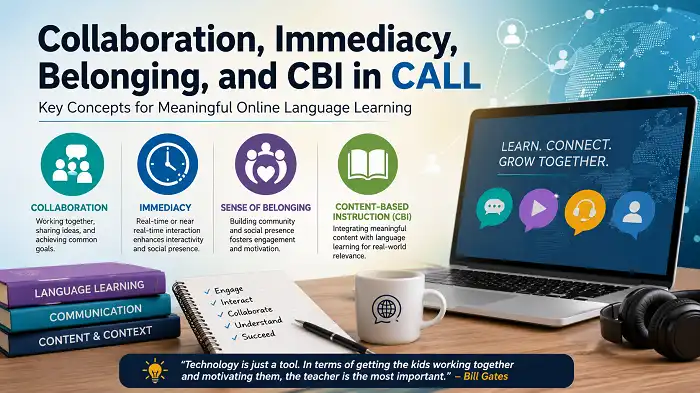
Very few practical guidelines currently exist to trigger more collaboration in online learning environments, although there is a great deal of enthusiasm and attention regarding collaborative learning (Palloff & Pratt, 2005). It is believed that any glance at materials for CALL on the Web indicates that CALL programs are still largely audio-lingual by nature in their emphasis on drill and practice, though they necessarily rely on the written language because of the computer’s limitations in dealing with speech (Cook, 2008; van den Branden, 2006).
After examining nine vocabulary-building programs (including Oxford Wordpower Vocabulary in Use) for different languages, Heid (1986, as cited in Nesselhauf & Tschichold, 2002) concluded that collocations were largely neglected in CALL, and according to Nesselhauf and Tschichold (2002), “as our investigation has shown, today, 15 years later, the situation has not greatly improved” (p. 270). They further make the following suggestions to improve commercial vocabulary programs in the field of CALL (Nesselhauf & Tschichold, 2002, p. 271):
- Better specification of the proficiency level the program aims at
- Consistent context-embedding of the items learned
- More flexibility of feedback (at least, so that alternative correct answers are not rejected)
- At least some variety in the exercises
- An inclusion of sections that teach besides sections that test
It is a commonplace to say that the acceptance and integration of CALL into language curricula have remained a crucial and unresolved issue. It seems that CALL per se does not make a difference to performance and skills in language learning. To overcome this problem, the integration of networking, which sets up a more thoroughly computer-based working environment, appears to be of primary importance (Gillespie & McKee, 1999). In this response, Gunn and Brussino (1997, as cited in Gillespie & McKee, 1999) maintain, “Teachers with full workloads and satisfactory outcomes from existing methods of course delivery are not necessarily motivated to venture into the unchartered waters of technology-based developments which are sometimes hard to access, often unreliable and always costly” (p. 21).

Some computer programs might include activities that lack the interaction upon which the language development process is based. Therefore, they might impede the establishment of authentic communication (Brine & Franken, 2006; Lasagaba-ster & Sierra, 2003, as cited in Fidaoui, Bahous & Bacha, 2010).
Laurillard (2001, as cited in Vandewaetere & Desmet, 2009) casts doubt on the efficacy of CALL in SLA and motivating the learners in this way:
More and more, we need to drop the naïve belief in the surplus view of new technologies in learning and the naïve conclusion that ICT has a positive impact on motivation, simply because there is a large discrepancy between the specific questions asked in evaluation studies in new technology, and the often predictable conclusions they come to (p. 351).
Having considered the aforementioned points recorded in the literature on the significance of an integrative type of CALL to account for an optimum level of interactivity among the students and between the students and the teacher, the researcher intends to investigate the prospect of realizing the sense of social presence through facilitating and encouraging student-student interactivity and collaborative learning in a carefully engineered social context.

One of the marked dividing lines between the current study and the other ones of the same ilk is the point that, as specified by Chapelle and Jamieson (2008), in CALL studies, teachers are often frustrated with inadequate opportunities bestowed upon the learners to produce the language in action. Bearing this deficit in L2 learners’ productivity, autonomy, activeness, and certainly interactivity in mind, the researcher aims to fill in this discrepancy (inadequacy of L2 learners’ interactivity and productivity) by presenting pragmatic solutions to the issue, which will be comprehensively discussed in the chapters to come.
References
- Armitage, N., & Bowerman, C. (2002). Knowledge pooling in CALL: Programming an online language learning system for reusability, maintainability and extensibility. Computer Assisted Language Learning, 15(1), 27-53. doi:10.1076/call.15.1.27.7288
- Bax, S. (2003). CALL – past, present and future. System, 31(1), 13-28. doi:10.1016/s0346-251x(02)00071-4
- Beatty, K., & Nunan, D. (2004). Computer-mediated collaborative learning. System, 32(2), 165-183. doi:10.1016/j.system.2003.11.006
- Brinton, D. (2003). Content-based instruction. In D. Nunan (Ed.), Practical English language teaching (pp. 199-224). New York, NY: McGraw Hill.
- Chapelle, C. (1997). CALL in the Year 2000: Still in search of research paradigms? Language Learning and Technology, 1(1), 19-43.
- Chapelle, C., & Jamieson, J. (1986). Computer-assisted language earning as a predictor of success in acquiring English as a second language. TESOL Quarterly, 20(1), 27-45. doi:10.2307/3586387
- Cook, V. (2008). Second language learning and second language teaching. London, UK: Hodder Education, Inc.
- Cushion, S., & Hémard, D. (2002). Applying new technological developments to CALL for Arabic. Computer Assisted Language Learning, 15(5), 501-508. doi:10.1076/call.15.5.501.13472
- Cushion, S., & Hémard, D. (2003). Designing a CALL package for Arabic while learning the language ab initio. Computer Assisted Language Learning, 16(2-3), 259-266. doi:10.1076/call.16.2.259.15883
- Desmarais, L., Laurier, M., & Reni, D. (1998). The analysis of navigation patterns in CALL. Computer Assisted Language Learning, 11(3), 309-315. doi:10.1076/call.11.3.309.5681
- Farmer, R., & Gruba, P. (2006). Towards model-driver end-user development in CALL. Computer Assisted Language Learning, 19(2), 149-191. doi:10.1080/09588220600821529
- Fidaoui, D., Bahous, R., & Bacha, N. N. (2010). CALL in Lebanese elementary ESL writing classrooms. Computer Assisted Language Learning, 23(2), 151-168. doi:10.1080/09588221003666248
- Gillespie, J., & McKee, J. (1999). Does it fit and does it make any difference? Integrating CALL into the curriculum. Computer Assisted Language Learning, 12(5), 441-455. doi:10.1076/call.12.5.441.5692
- Hall, D. R., & Knox, J. S. (2009). Language teacher education by distance. In A. Burns & J. C. Richards (Eds.), The Cambridge guide to second language teacher education (pp. 218-229). Cambridge: Cambridge University Press.
- Hauck, M., & Warnecke, S. (2013). Materials design in CALL: Social presence in online environments. In M. Thomas, H. Reinders & M. Warschauer (Eds.), Contemporary computer-assisted language learning (pp. 95-115). London, UK: Bloomsbury Academic.
- Hubbard, P. (2005). A review of subject characteristics in CALL research. Computer Assisted Language Learning, 18(5), 351-368. doi:10.1080/09588220500442632
- Hubbard, P. (2009). Educating the CALL specialist. Innovation in Language Learning and Teaching, 3(1), 3-15. doi:10.1080/17501220802655383
- Jones, G. (1986). Computer simulations in language teaching—The Kingdom experiment. System, 14(2), 179-186. doi:10.1016/0346-251x(86)90007-2
- Kecskés, I. (1988). Computer programs to develop both accuracy and fluency. System, 16(1), 29-35. doi:10.1016/0346-251x(88)90007-3
- Kessler, G., & Plakans, L. (2008). Does teachers’ confidence with CALL equal innovative and integrated use? Computer Assisted Language Learning, 21(3), 269-282. doi:10.1080/09588220802090303
- Leahy, C. (2008). Learner activities in a collaborative CALL task. Computer Assisted Language Learning, 21(3), 253-268. doi:10.1080/09588220802090295
- Lee, K. W. (2000). English teachers’ barriers to the use of computer-assisted language learning. The Internet TESL Journal, 6(12).
- Levy, M. (1997). Computer-assisted language learning: Context and contextualization. Oxford: Oxford University Press.
- Levy, M. (1998). Review of computer-assisted language learning: Context and conceptualization. Language Learning & Technology, 2(1), 17-18.
- Levy, M., & Stockwell, G. (2006). CALL dimensions: Options and issues in computer-assisted language learning. Mahwah, NJ: Lawrence Erlbaum.
- Lewis, T. (2006). When teaching is learning: A personal account of learning to teach online. CALICO Journal, 23(3), 581-600.
- Nesselhauf, N., & Tschichold, C. (2002). Collocations in CALL: An investigation of vocabulary-building software for EFL. Computer Assisted Language Learning, 15(3), 251-279. doi:10.1076/call.15.3.251.8190
- Nunan, D. (1988). Syllabus design. Oxford: Oxford University Press.
- Nunan, D. (1999). Second language teaching and learning. Boston, MA: Heinle and Heinle Publishers.
- Palloff, R. M., & Pratt, K. (2005). Collaborating online: Learning together in community. San Francisco, CA: Jossey-Bass.
- Paran, A., Furneaux, C., & Sumner, N. (2004). Computer-mediated communication in distance MA programmes: The student’s perspective. System, 32(3), 337-355. doi:10.1016/j.system.2004.02.007
- Poel, K., & Swanepoel, P. (2003). Theoretical and methodological pluralism in designing effective lexical support for CALL. Computer Assisted Language Learning, 16(2-3), 173-211. doi:10.1076/call.16.2.173.15878
- Reinders, H. (2009). Technology and second language teacher education. In A. Burns & J. C. Richards (Eds.), The Cambridge guide to second language teacher education (pp. 230-238). Cambridge: Cambridge University Press.
- Sengupta, S. (2001). Exchanging ideas with peers in network-based classrooms: An aid or a pain? Language Learning & Teaching, 5(1), 103-134.
- Shetzer, H., & Warschauer, M. (2000). An electronic literacy approach to network-based language teaching. In M. Warschauer & R. Kern (Eds.), Network-based language teaching: Concepts and practice (pp. 171-185). New York, NY: Cambridge University Press. doi:10.1017/cbo9781139524735.010
- Stockwell, G. (2009). Teacher education in CALL: Teaching teachers to educate themselves. Innovation in language learning and teaching, 3(1), 99-112. doi:10.1080/17501220802655524
- van den Branden, K. (2006). Task-based language education: From theory to practice. Cambridge: Cambridge University Press.
- Vandewaetere, M., & Desmet, P. (2009). Introducing psychometrical validation of questionnaires in CALL research: The case of measuring attitude towards CALL. Computer Assisted La Learning, 22(4), 349-380. doi:10.1080/09588220903186547
- Warschauer, M. (2005). Sociocultural perspectives on CALL. In J. Egbert & G. M. Petrie (Eds.), CALL Research Perspectives (pp. 41-51). Mahwah, NJ: Lawrence Earlbaum.