
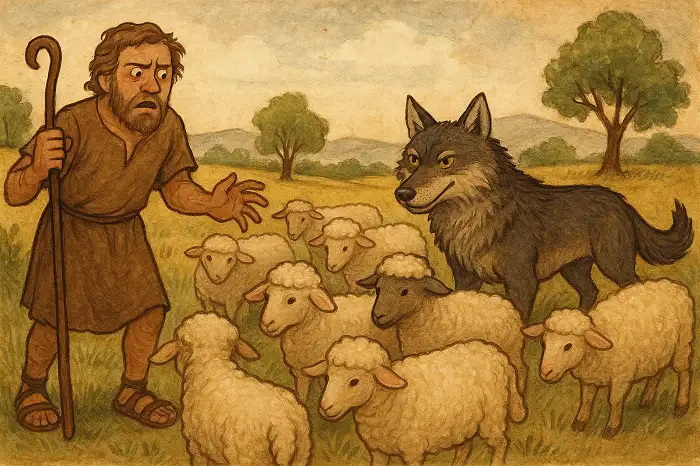
The Wolf and the Shepherd by Aesop for ESL students with a video, vocabulary practice in real context, questions for discussion, and the moral of the short story Video of the Wolf and the Shepherd https://www.youtube.com/watch?v=zBBiq8rFHpM&t=4s The Wolf and the Shepherd A wolf hung around a flock of sheep for a long time but didn’t try to harm them. At first, the shepherd was very cautious and watched him closely, assuming he was up to no good. But as time passed and the wolf made no move to attack, the shepherd began to relax. Eventually, he started to see the ...
The Wolf and the Shepherd by Aesop for ESL Students
About the Author

Related Posts



We can learn from this story that we shouldn’t trust people too quickly, because if we trust them blindly, we will make a big mistake and we can’t make up for the mistake easily.
Your comment was both accurate and meaningful. Just a minor grammar point to make:
When because appears in the middle of a sentence, it usually introduces an essential reason for the main clause, so no comma is used before it (e.g., She stayed home because she was sick.). However, when a because clause comes at the beginning of a sentence, it is a dependent clause placed before the main clause, so it is followed by a comma (e.g., Because she was sick, she stayed home.). The comma helps separate the introductory dependent clause from the main clause.
Yes, you’re right. Thanks for telling me about it .
Anytime. It’s my pleasure.
The story teaches us that we should not trust someone only because they pretend to be kind. Finally, one day the true nature appears.
This situation shows that trust should be built carefully and verified over time.
Thank you Nasim for your wise words. You’re pointing to the central theme of this short fable. In English, we say:
2. Not really, because the wolf could not change his nature.
Precisely. According to the proverb mentioned in this lesson:
1. The shepherd begin to trust the wolf, because of his calm appearance. It seems that he wants to be guardian.
Corrections:
1. The shepherd begins to
2. he wants to be guardian = he wants to be the shepherd’s guardian.
Guardian is a countable noun.