Table of Contents
- Video of Three Types of Assessment in CALL
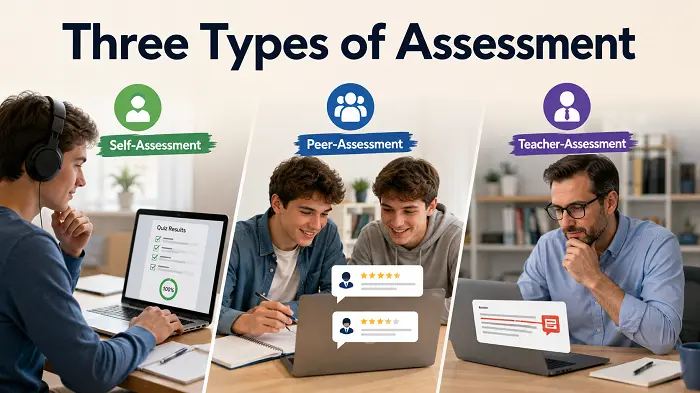
- Three Types of Assessment
- Self-Assessment
- Learning Management Systems and Self-Assessment
- Web-Based Tools for Self-Assessment
- Digital Portfolios and Learner Autonomy
- Peer-Assessment
- Online Peer Review
- Peer Interaction and Negotiation of Meaning
- Peer Feedback and Learner Autonomy
- Teacher-Assessment
- Teacher Feedback and Error Correction
- Teacher-Assessment in Online Communication
- References
Explore three important types of assessment in computer-assisted language learning (CALL): self-assessment, peer-assessment, and teacher-assessment. This article examines how digital tools, learning management systems, online peer review, digital portfolios, grammar checkers, and teacher feedback can support language learning. It also discusses learner autonomy, collaboration, negotiation of meaning, error correction, and the role of technology in making assessment more effective and meaningful for language learners.
Video of Three Types of Assessment in CALL

Three Types of Assessment
Any specific technology might show great educational potential. However, only can this potential be realized when technology is utilized appropriately to yield positive results for the learners. As a consequence, according to Zhao (2003), “assessing the effectiveness of a technology is in reality assessing the effectiveness of its users rather than the technology itself” (p. 8). In this regard, the efficacy of any CALL-based educational approach is determined by some variables, including the task, the leaners, the assessment tool, the instructional setting, and the teacher (Zhao, 2003).
Self-Assessment
Modern technology and recent models of professional development for teachers have made the process of self-assessment easier and more feasible (Frommer, 2006; Horton & Horton, 2003; McCombs, 1997). For instance, regarding listening comprehension, self-assessment could be programmed in a way that verification of accurate listening abilities could occur after a short chunk of listening in which the students are prevented from continuing until they have found the correct responses (Frommer, 2006).
Learning Management Systems and Self-Assessment
Learner Management Systems (LMSs) are appropriate tools for tracking the students’ progress with the help of various exercises. LMSs – as a kind of portfolio assessment – provide this opportunity for the learners to keep a proper record of the stream of their individual activities reflected in their own profiles or accounts on the blog so that they could evaluate their own progress (Wang, 2006).
LMSs can also facilitate the process of self-evaluation by allowing the learners to print out the stream of their activities, such as the elapsed time for the completion of each task or activity, the total number of completed tasks or exercises, and the like. One of the best suited Web-ready self-assessment programs is Hot Potatoes with which it is perfectly possible to create multiple-choice questions, crossword puzzles, fill-in-the-blank questions, matching exercises, short-answer quizzes, and the like, and then e-mail scores to the instructor via a server script (Horton & Horton, 2003).
Web-Based Tools for Self-Assessment
Chen (2011) conducted a study to test the effectiveness of a web-based collocation retrieval tool, WebCollocate, on the basis of a large-scaled speech-tagged Gutenberg corpus utilized by a group of college EFL students to find proper collocates in translation tasks from Chinese into English without any teacher-assessment. The performance of this group was compared to another identical one that did not use WebCollocate. The results revealed that the students using WebCollocate could locate more proper English collocates compared to the other group, thus performing self-assessment in their translation tasks more appropriately.
Digital Portfolios and Learner Autonomy

According to Vrasidas, Landone, Christodoulou and Zembylas (2006), the employment of digital portfolios in CALL programs can help the learners to reflect upon and evaluate the process of their own learning. Digital portfolios as “the collection of selected pieces of work by students” (Vrasidas et al., 2006, p. 312) can help the learners to review, revise and update their own online contributions, analyze their learning strategies, evaluate their participation in virtual classes, and turn the spotlight of learning on themselves (the learners), rather than the teachers, thus increasing student autonomy and reflectivity.
Peer-Assessment

Peer-Assessment in CALL
The opportunity for students to learn through collaborating with each other, instead of exclusively with the teacher, is a topic of much concern and interest to pedagogues and educational researchers (Coit, 2006; DiGiovanni & Nagaswami, 2001; Foster & Ohta, 2005; Gaytan & McEwen, 2007; Keh, 1990; Webb, 1989). Peer-directed small group learning, as a pattern of peer-assessment, according to Webb (1989), is one effective collaborative problem-solving activity to improve student learning and student motivation. This type of peer-assessment can also aid the teachers of classes with large numbers of students with managing all the class activities. Coit (2006) believes that any type of peer-assessment (compared to exclusive teacher-assessment) can strengthen the social and interpersonal skills and bonds in and among the learners by practicing being both the receiver and giver of assistance and feedback.
Online Peer Review
DiGiovanni and Nagaswami (2001) conducted a study to compare and contrast face-to-face peer review (FFPR) and online peer review (OLPR) with each other. The results indicated that the students remain on task and focused as long as they are online. That is to say, OLPR does increase the level of attention in the students. Another advantage of OLPR over FFPR is that teachers can monitor students’ interaction much more closely in comparison to face-to-face situations, where only bits of conversation can be heard as they circulate among the peer dyads.

Furthermore, if the teacher finds a peer dyad or an individual student making general or superficial comments, he/she can redirect them toward specific comments and critical and analytical negotiations. Additionally, unlike FFPR, in OLPR, the students do not need to rely on their memories to revise their drafts based on their peers’ oral comments because they can depend on the printouts. Teachers can also monitor and train peer dyads individually, and assess the impact of the peer review on their revised drafts.
Peer Interaction and Negotiation of Meaning
On the significance of peer assessment in generating a sense of interactivity among L2 learners, Foster and Ohta (2005) assert that “interactional processes including negotiation for meaning and various kinds of peer assistance and repair are among the main ways learners gain access to the language being learned” (p. 426). Almost three decades before Foster and Ohta’s (2005) study, Vygotsky (1978) had argued that in meaningful peer interaction, learners can assist each other in improving their performance in comparison to learning in isolation.
Peer Feedback and Learner Autonomy

The advantages of peer-assessment are not merely restricted to exchanging feedback among the learners (Coit, 2006; Keh, 1990; Webb, 1989). Keh (1990) undertook a study on the influence of peer-assessment in a writing course in which peer feedback on the writing process was emphasized. The results obtained from a questionnaire on peer feedback together with end-of-course discussions revealed that peer feedback in writing tasks can help the learners to develop more profound grammatical knowledge of the second/foreign language.
Moreover, the learners can broaden the range of their audience as critiques (i.e., readers except the teacher). Besides, the readers (the other learners) acquire more knowledge about writing through critically reading and analyzing their peers’ products. Furthermore, peer-assessment, according to Keh (1990), can make a great contribution to the development of autonomy in the learners, thus saving teachers’ time noticeably and freeing them for more issues of concern.
Teacher-Assessment

Teacher-Assessment
Any type of CALL assessment should be a part of an ongoing evaluation of the technological tools alongside the sequence of online activities monitored by the teacher (Burston, 2006). As advised by Chapelle (2001), online language teachers should employ recently developed software programs, which are called grammar checkers, to perform text analysis. These intelligent programs have been designed to provide an automatic assessment of outward or surface features of the learners’ writing tasks in a large scale and direct the teacher’s attention to the grammatical errors in the writing tasks submitted and posted by the students. In so doing, the teacher – particularly in large classes with numerous writing tasks – is not required to peruse the entire essays or writing tasks to locate problematic parts.
Teacher Feedback and Error Correction
On the significance of performing teacher-assessment in the form of error-correction, Chapelle (1997) contends that online L2 teachers are responsible for drawing the learners’ attention to linguistic forms (focus on form) from two perspectives: (1) the formal features of the linguistics input, and (2) linguistic output that the learners produce. Chapelle (1997) proposes the following consciousness-raising activities and techniques that could be used by the teachers to call the learners’ attention to linguistic forms: displaying hot spots with links to supporting materials, highlighting relevant forms, and signaling learners when they have made mistakes or errors.
Teacher-Assessment in Online Communication
Blake (2000) undertook a study on 50 intermediate L2 Spanish learners in which the participants held networked discussions in pairs using a synchronous chat program called Remote Technical Assistance (RTA), which recorded all textual entries. The findings suggested that although the participants could perform negotiation of meaning through instantaneous chatting, there existed a noticeable insufficiency of grammatical development reflected in the recorded history of the chat program.
The study concluded that the participants went through an abundance of incidental lexical negotiations at the cost of overlooking syntactic negotiations, which led to the underdevelopment of grammar knowledge. In the end, it was proposed that teacher-assessment in the form of error correction – even in utterly communicative tasks, such as negotiation of meaning – is an important factor that should not be disregarded.
References
- Blake, R. (2000). Computer mediated communication: A window on L2 Spanish interlanguage. Language Learning & Technology, 4(1), 120–136.
- Burston, J. (2006). Working toward effective assessment of CALL. In R. P. Donaldson & M. A. Haggstrom (Eds.), Changing language education through CALL (pp. 249–270). New York, NY: Routledge.
- Chapelle, C. (1997). CALL in the Year 2000: Still in search of research paradigms? Language Learning and Technology, 1(1), 19–43.
- Chapelle, C. A. (2001). Computer applications in second language acquisition: Foundations for teaching, testing and research. Cambridge: Cambridge University Press.
- Chen, H. H. (2011). Developing and evaluating a web-based collaboration retrieval tool for EFL students and teachers. Computer Assisted Language Learning, 24(1), 59–76. doi:10.1080/09588221.2010.526945
- Coit, C. (2006). A student-centered online writing course. In P. Zaphiris & G. Zacharia (Eds.), User-centered computer aided language learning (pp. 94–115). Hershey, PA: Idea Group Inc. doi:10.4018/9781591407508.ch005
- DiGiovanni, E., & Nagaswami, G. (2001). Online peer review: An alternative to face-to-face? ELT Journal, 55(3), 263–272. doi:10.1093/elt/55.3.263
- Foster, P., & Ohta, A. S. (2005). Negotiation for meaning and peer assistance in second language classrooms. Applied Linguistics, 26(3), 402–430. doi:10.1093/applin/ami014
- Frommer, J. (2006). Wired for sound: Teaching listening via computers and the World Wide Web. In R. P. Donaldson & M. A. Haggstrom (Eds.), Changing language education through CALL (pp. 67–94). Oxford, UK: Routledge.
- Gaytan, J., & McEwen, B. C. (2007). Effective online instructional and assessment strategies. The American Journal of Distance Education, 21(3), 117–132.
- Horton, W., & Horton, K. (2003). E-learning tools and technologies: A consumer’s guide for trainers, teachers, educators, and instructional designers. Indianapolis, IN: Wiley Publishing, Inc.
- Keh, C. L. (1990). Feedback in the writing process: A model and methods for implementation. ELT Journal, 44(4), 294–304. doi:10.1093/elt/44.4.294
- McCombs, B. L. (1997). Self-assessment and reflection: Tools for promoting teacher changes toward learner-centered practices. NASSP Bulletin, 81(587), 1–14. doi:10.1177/019263659708158702
- Vrasidas, C., Landone, E., Christodoulou, N., & Zembylas, M. (2006). Language learning and user-centered design: The development of the electronic European language portfolio. In P. Zaphiris & G. Zacharia (Eds.), User-centered computer aided language learning (pp. 304–323). Hershey, PA: Idea Group Inc. doi:10.4018/9781591407508.ch014
- Vygotsky, L. S. (1978). Mind in society: The development of higher psychological processes. Cambridge, MA: Harvard College.
- Wang, X. (2006). Accomplishing more with less: An innovative approach to the development of curriculum-based courseware. In R. P. Donaldson & M. A. Haggstrom (Eds.), Changing language education through CALL (pp. 119–146). New York, NY: Routledge.
- Webb, N. M. (1989). Peer interaction and learning in cooperative small groups. Journal of Educational Psychology, 74(5), 642–655. doi:10.1037//0022-0663.74.5.642
- Zhao, Y. (2003). Recent developments in technology and language learning: A literature review and meta-analysis. CALICO Journal, 21(1), 7–27.