Table of Contents
Perigee is the point in an Earth-centered orbit where an object, such as the Moon or a satellite, comes closest to Earth during its orbital journey.
Definition of Perigee
Perigee /ˈperɪdʒiː/ (noun)
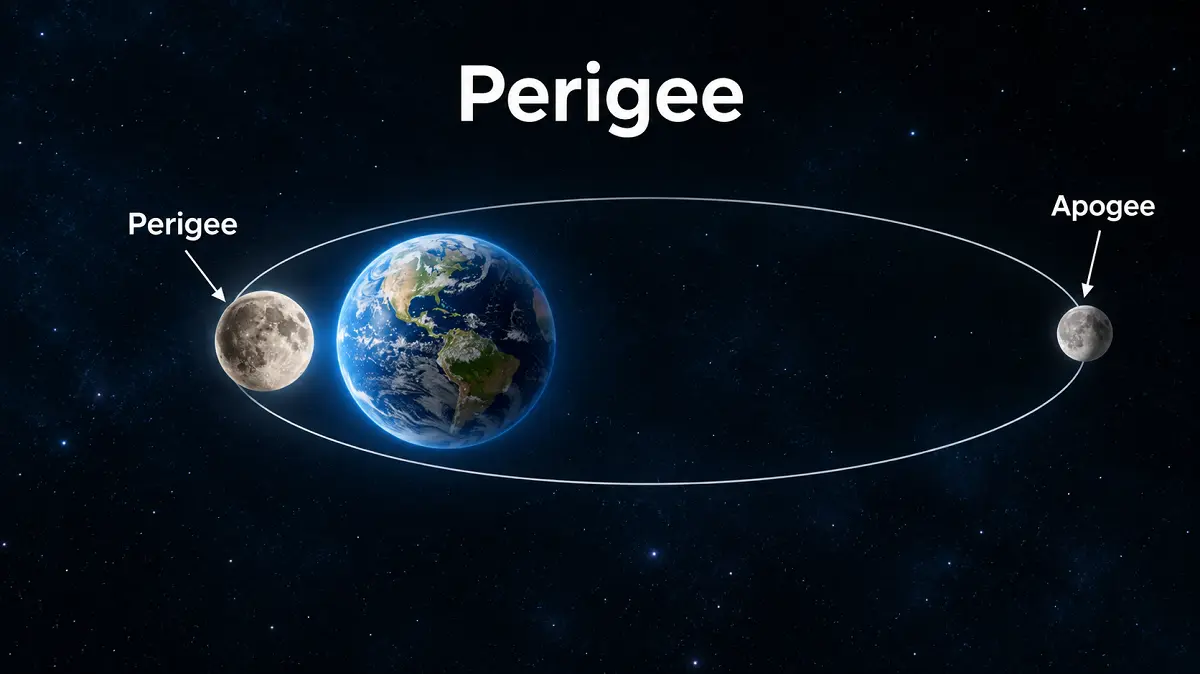
The perigee is the point in the orbit of an object around Earth at which the object is closest to Earth.
The term can describe the closest point reached by the Moon, an artificial satellite, a spacecraft, or another object traveling in an Earth-centered orbit. The opposite point, where the object is farthest from Earth, is called apogee.

For example, when the Moon reaches perigee, it is closer to Earth than it is at other points in its elliptical orbit. If a full moon occurs near perigee, it may appear somewhat larger and brighter than a full moon occurring when the Moon is farther away.
Synonyms and Antonyms of Perigee
Related term: periapsis — the general astronomical term for the point in an orbit that is closest to the primary body being orbited. Perigee is the specific term used when the primary body is Earth.
Antonym: apogee — the point in an Earth-centered orbit where an object is farthest from Earth.
Video of Perigee

Perigee in Context
The Moon does not travel around Earth in a perfectly circular orbit. Its orbit is slightly elliptical, so its distance from Earth changes continuously. When the Moon reaches its closest point to Earth, it is at perigee. As it continues along its orbit, it gradually moves farther away until it reaches apogee.

The difference in distance between perigee and apogee can affect how large the Moon appears in the sky. A full moon occurring close to perigee can appear slightly larger and brighter than one occurring near apogee. This phenomenon is commonly associated with the popular term supermoon, although not every perigee coincides with a full moon.

The concept of perigee is also important for artificial satellites and spacecraft orbiting Earth. Engineers and scientists monitor an object’s orbital position, including its perigee and apogee, because changes in orbital distance can affect factors such as orbital speed, atmospheric drag, and the planning of spacecraft operations.
Parts of Speech of Perigee
- Adjective: perigeal
- Adjective: perigean
Origin of Perigee
Perigee comes from Greek perigeion, meaning “near the Earth.” It is formed from peri- meaning “near” or “around” and gē meaning “Earth.” The term entered scientific English through New Latin perigeum and has been used in astronomy to describe the closest point of an Earth-centered orbit.