Table of Contents
- Video of ICT and Synchronous Communication
- Information and Communication Technology (ICT)
- The Web as a Source of Authentic Materials
- ICT vs. CALL
- Features of Effective CALL Programs
- Synchronous Computer-Mediated Communication (SCMC)
- Research on SCMC and Communication
- Voice-Based SCMC and Speaking Skills
- Internet Relay Chat (IRC) and Instant Messaging
- Educational Benefits of Chat Programs
- References
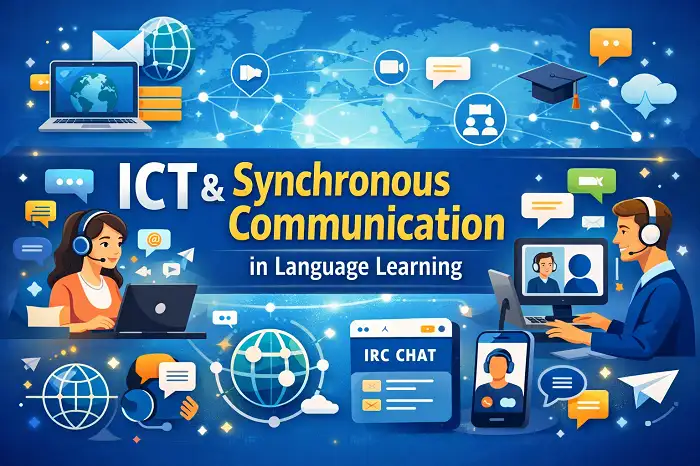
Information and Communication Technology (ICT) has transformed language learning by providing access to authentic materials, interactive tools, and online communication platforms. From general-purpose software to advanced Computer-Assisted Language Learning (CALL) programs, ICT offers learners and teachers opportunities to improve language skills effectively. Synchronous computer-mediated communication (SCMC) and instant messaging platforms allow real-time interaction, enhancing collaboration, self-correction, and speaking practice for L2 learners. This post explores the role of ICT and SCMC in modern language education, highlighting research findings and practical applications.
Video of ICT and Synchronous Communication

Information and Communication Technology (ICT)
Information and Communication Technology (ICT) refers to a wide variety of technologies that move well beyond general-purpose generic computer tools, such as emails, word processors and databases of different kinds (Levy & Hubbard, 2005). ICTs have made a strong and positive influence on the language teaching classrooms and combined with the resources available through the World Wide Web and the Internet embrace many of the technologies that are frequently used by language teachers and learners.
The Web as a Source of Authentic Materials

The Web is a comprehensive source of content as a window to the wider world outside the class, thus it is an available collection of authentic materials (Dudeney & Hockly, 2007). In addition, the technology needed to use the Internet for educational purposes is reasonably limited, and the odds of encountering major problems in using the Web for learning are relatively weak. Furthermore, as stated by Dudeney and Hockly (2007), the students do not necessarily have to rely upon a constantly stable Internet connection as they can save local copies of the located content on their computers or other digital devices. Also the students can simply print out useful pages for later use.
ICT vs. CALL

Levy and Hubbard (2005) maintain that ICT and CALL are not exactly interchangeable. They believe that ICTs are limited to the goals and needs of the language classroom, and fail to reflect the research, design and development arms of CALL and the work that goes into making and evaluating new language learning tutors and tools. Furthermore, ICTs represent well-established mainstream technologies generally designed for the native speakers of English. However, CALL makes a good contribution especially to non-native speakers of English, and even other languages.
Features of Effective CALL Programs
Kecskés (1986) undertook a study in Hungary to evaluate the performance of three types of computer programs developed in English and Russian to account for both accuracy and fluency. The results of the study illuminated this point that any computer program on the premise of communicative CALL must have at least the following three features to achieve optimum success: (1) the program must be complex, cyclical and generative (CCG), (2) it must make preparatory adjustments to help the learners fulfil compensatory competency, and (3) it must offer real communicative work to accommodate requisite interaction.
Synchronous Computer-Mediated Communication (SCMC)
Synchronous CMC refers to real-time interaction between people over either a local or wide area network (Smith, 2004). In this mode of communication, messages are typed, sent and received instantaneously and the communicators are supposed to interact with each other in the same session. It has been argued that SCMC interactions provide learners with more additional processing and planning time than face-to-face interactions. In addition, SCMC may provide learners with enhanced visual saliency of complex or low-salience forms (Smith, 2003; Smith, 2010, as cited in Mackey, 2012; Vandergriff, 2006). Furthermore, Lai and Zhao (2006) noticed that online chat interactions result in more occurrences of learner self-correction in comparison to face-to-face interactions, with 10 out of 12 participants providing more self-correction during the online tasks.
Research on SCMC and Communication
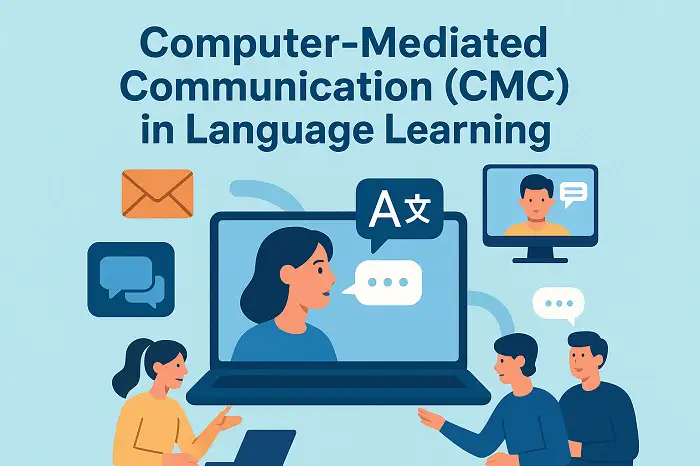
Vandergriff (2006) carried out a study to compare face-to-face and synchronous CMC to ascertain how the communication medium affects grounding or the collaborative efforts of two or more communicators to establish shared information or beliefs. The results indicated that SCMC promotes negotiation by affecting the communicative interaction among L2 learners and encouraging them to play a greater role in managing the discourse. Furthermore, according to Chapelle and Jamieson (2008), computers can trigger communication between teachers and students and among students through providing appropriate input, particularly by facilitating oral communication.
Voice-Based SCMC and Speaking Skills

Alastuey (2011) conducted a study on the impact of synchronous voice-based CMC (SVCMC) on the level of achievement obtained by L2 students of English. The results indicated that SVCMC can help the students to improve their speaking skills because Voice over Internet Protocol (VoIP) tools provide L2 learners with ample opportunities to practice negotiation of meaning.
Internet Relay Chat (IRC) and Instant Messaging

Internet Relay Chat (IRC) or Instant Messaging is a text-based synchronous communication tool to send and receive short messages among online users, which requires them to install a client program, namely Yahoo Messenger, MSN Messenger, Google Talk, etc. (Dudeney & Hockly, 2007; Manning & Johnson, 2011). In recent instant messaging software programs, namely Skype, e-learners can exchange files and hold voice conferences besides chatting. However, IRC was initially used for group meetings in many online courses before the emergence of video and voice conferencing (Manning & Johnson, 2011).
Educational Benefits of Chat Programs
Chat programs are becoming increasingly popular in educational institutions (Chapelle & Jamieson, 2008). Using chat for educational purposes can strongly motivate the learners because, on the one hand, it is real-time communication, and on the other hand, chatting opens up the possibility of accommodating even overseas students throughout the entire globe (Dudeney & Hockly, 2007). Examining the logs from chat sessions can help teachers to recycle language that students interactively generate in order to create a variety of different exercises (Chapelle & Jamieson, 2008).
References
- Alastuey, M. C. B. (2011). Perceived benefits and drawbacks of synchronous voice-based computer mediated communication in the foreign language classroom. Computer Assisted Language Learning, 24(5), 419-432. doi:10.1080/09588221.2011.574639
- Chapelle, C. A., & Jamieson, J. (2008). Tips for teaching with CALL: Practical approaches to computer-assisted language learning. New York, NY: Pearson-Longman. 211 INTERACTIVITY AND SOCIAL PRESENCE IN CALL
- Dudeney, G., & Hockly, N. (2007). How to teach English with technology. Harlow, UK: Pearson Education Limited.
- Kecskés, I. (1988). Computer programs to develop both accuracy and fluency. System, 16(1), 29-35. doi:10.1016/0346-251x(88)90007-3 218 INTERACTIVITY AND SOCIAL PRESENCE IN CALL
- Lai, C., & Zhao, Y. (2006). Noticing in text-based online chat. Language Learning and Technology, 10(3), 102-120.
- Levy, M., & Hubbard, P. (2005). Why call CALL ‘‘CALL’’? Computer Assisted Language Learning, 18(3), 143-149. doi:10.1080/09588220500208884
- Mackey, A. (2012). Input, interaction, and corrective feedback in L2 learning. Oxford: Oxford University Press.
- Manning, S., & Johnson, K. E. (2011). The technology tool belt for teaching. San Francisco, CA: Jossey-Bass.
- Smith, B. (2003). The use of communication strategies in computer-mediated communication. System, 31, 29-53. doi:10.1016/s0346-251x(02)00072-6
- Smith, B. (2004). Computer-mediated negotiated interaction and lexical acquisition. Studies in Second Language Acquisition, 26(3), 365-398. doi:10.1017/s027226310426301x
- Vandergriff, I. (2006). Negotiating common ground in computer-mediated versus face-to-face discussions. Language Learning & Technology, 10(1), 110-138. 228 INTERACTIVITY AND SOCIAL PRESENCE IN CALL