Table of Contents
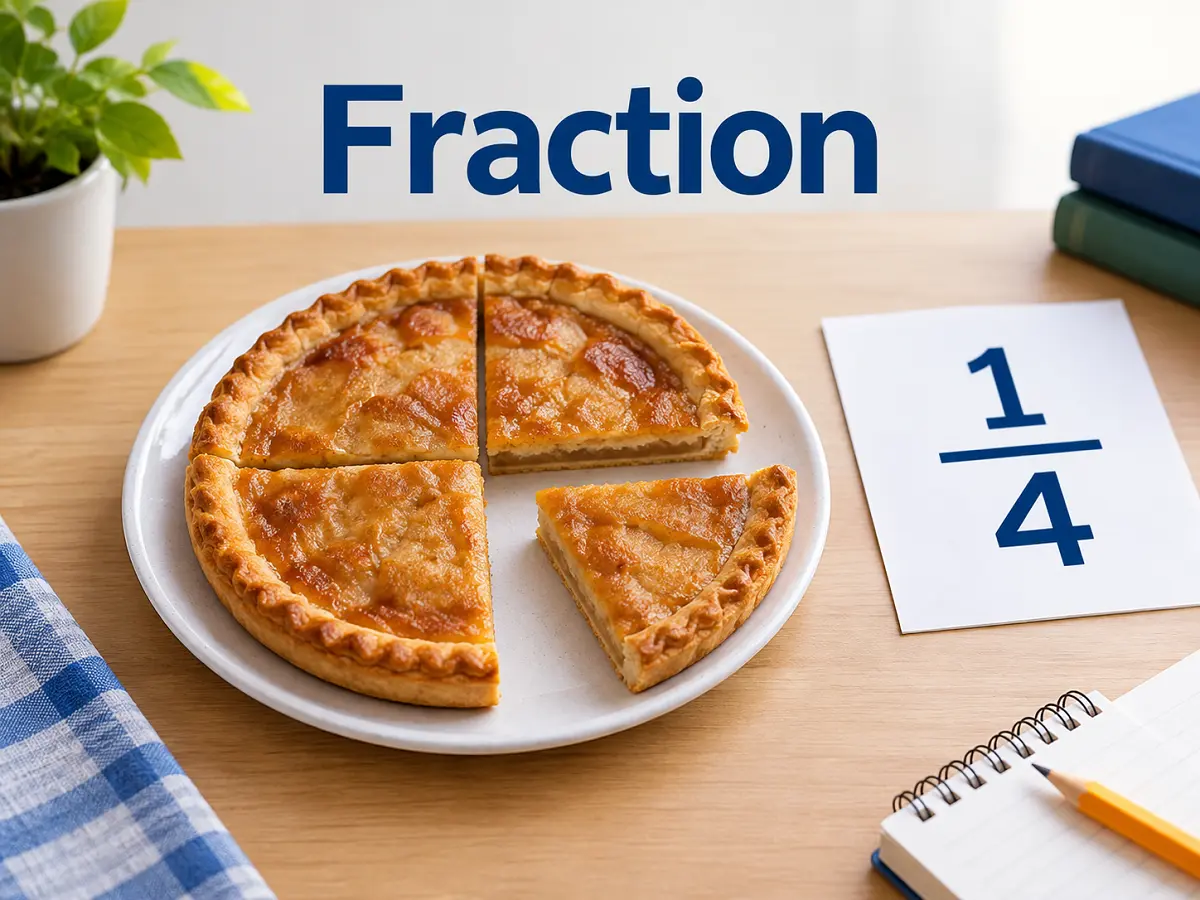
A fraction is a part or proportion of a whole, often expressed mathematically as a number representing equal parts of a unit. It can also refer to a small amount of something.
/ˈfræk.ʃən/ (Noun)
Definition of Fraction
A fraction is a noun that refers to a part of a whole, a small proportion of a quantity, or a mathematical expression representing the division of one number by another.
In mathematics, a fraction is commonly written with a numerator above a denominator, separated by a horizontal line. For example, (3/4) means three out of four equal parts of a whole. In everyday English, the word can describe a small amount of something, as in a fraction of the population or a fraction of a second.
Synonyms and Antonyms of Fraction
Synonyms:
- Part
- Portion
- Segment
- Share
- Proportion
These words are related in meaning, although their precise usage depends on the context. For example, segment often refers to a distinct section, whereas proportion emphasizes a part’s relationship to the whole.
Antonyms:
- Whole
- Entirety
- Totality
These words express the idea of something complete rather than a part of it. However, they are contextual opposites rather than direct antonyms in every mathematical or everyday use.
Video of Fraction

Fraction in Context
When the mathematics teacher introduced fractions, she divided a circular cake into eight equal slices to help her students understand the concept. She explained that if a student ate three slices, they would have eaten three-eighths of the cake, or (3/8). By using a familiar example, she helped the class understand how fractions represent parts of a whole.
The researchers also used the word fraction when presenting the results of their survey. They discovered that only a small fraction of the participants had completed the advanced training program. Although the majority had expressed interest in further education, relatively few had managed to meet all the requirements. This finding encouraged the research team to investigate the barriers preventing wider participation.
During the final stage of the experiment, the scientists noticed a fraction of a second’s difference between the two recorded measurements. Although the difference was extremely small, it was important enough to warrant further examination. They repeated the experiment several times to determine whether the discrepancy resulted from measurement error or reflected a genuine variation in the results.
Parts of Speech of Fraction
- Adjective: fractional
- Adverb: fractionally
- Verb: fractionalize
Origin of Fraction
The word fraction entered English in the late fourteenth century through Anglo-French fraccioun, derived from Late Latin fractio, meaning “a breaking” or “a breaking into pieces.” The Latin noun comes from frangere, meaning “to break.” This origin reflects the central idea of a fraction as a part separated from a larger whole. Over time, the word developed its mathematical meaning and its broader everyday use to describe a portion or a small amount.