Table of Contents
Computer-Assisted Language Learning (CALL) has revolutionized language education since its emergence in the 1960s. This comprehensive review explores the evolution of CALL across three major stages — behavioristic, communicative, and integrative — highlighting how technology has transformed teaching and learning practices in second or foreign language education. From grammar drills and syntax exercises to interactive multimedia platforms and socio-collaborative environments, CALL reflects a dynamic integration of technology, pedagogy, and theory. Learn how CALL evolved into a theory-driven field shaping modern language learning.
Video of History and Evolution of CALL

History of CALL
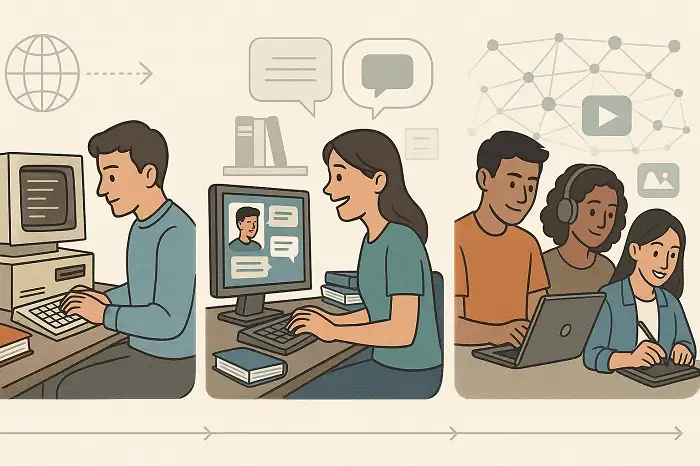
Computers have been utilized for second/foreign language learning and teaching from the 1960s (Lamy & Hampel, 2007; Lee, 2000; Ng & Oliver, 1987; Wyatt, 1983). This lengthy period of time can technically be divided into the following three main stages: behaviorist, communicative, and integrative CALL. In the 1960s, computer assisted language instructional projects in the U.S.A. were conducted experimentally to assess the efficacy of computer assisted instruction (CAI) vis-à-vis traditional instructional modes that mainly consisted of grammar and syntax drills translation and dictation exercises (Ng & Oliver, 1987).

The widespread use of Local Area Networks (LANs) in the early 1990s made it possible for learners to transcend the computer-learner interaction phase and enter the learner-learner interaction one, thanks to the existence of networked computers (Chapelle, 2001). In early CALL programs, computers adopted the role of tutors, interacting with the learners in a computer-human communication mode. Nevertheless, CMC caused a paradigm shift, altering the computer-human interaction mode to a human-human one (Simpson, 2002).
Behavioristic CALL

CALL has undergone different phases in its history (Chapelle, 2001; Lamy & Hampel, 2007; Warschauer, 1996). Warschauer (1996) argues that the first phase of CALL is a behavioristic one consisting of repeated drill and practice. These drills and exercises (usually reading and writing ones) are provided by the computer, and the L2 learners generally practice them individually. Warschauer (1996) offers the following reasons for labeling the first phase of CALL behavioristic:
- Repeated exposure to the same material is both beneficial and essential for learning.
- A computer is ideal for carrying out repeated drills, since the machine does not get bored with presenting the same material, and since it can provide immediate and non-judgmental feedback.
- A computer can present such materials on an individualized basis, allowing students to proceed at their own pace and freeing up class time for other activities.
van den Branden (2006) criticizes the behavioristic phase of CALL for the following:
- The employed subject matters are usually insufficiently interesting and relevant when compared to the needs of the students. The curriculum design is basically driven by considerations related to the linguistic complexity of the content.
- This phase of CALL is problematic when used to justify the use of a computer in a task-based approach.
- Most of the time, a functional context is completely absent. Consequently, the immediate feedback provided is very much targeted toward the linguistic correctness of the expected answer.
- The learner is not in control of the interaction. The order in which material is presented and the way it is presented are not determined by the user’s preferences, but by the program’s internal logic, the latter again being dictated by a structure-based view of language.
Communicative CALL
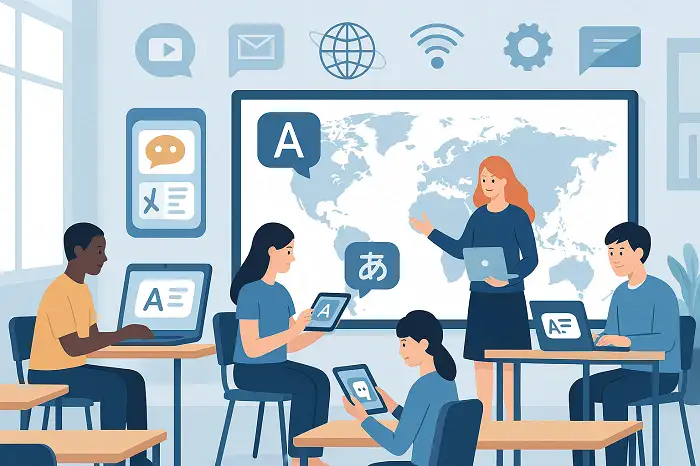
There are basically two recent orientations toward CALL: (1) communicative CALL, and (2) integrative CALL. The key distinction between communicative CALL and integrative CALL is that, in the former, learner’s choices and managerial activities are driven by task-based approaches to syllabus design. However, a syllabus in an integrative CALL represents a dynamic blueprint where learning occurs through accidents generated by projects (Barson, 1999, as cited in Gruba, 2004).
In the 1980s, thanks to the spread of the Internet in communicative teaching, more interactive approaches to second/foreign language teaching were adopted by CALL in which greater student control and choice was encouraged. (Kukulska-Hulme, 1988; Lamy & Hampel, 2007). Communicative CALL is based on cognitive theories of learning where problem-solving and hypothesis testing approaches are encouraged. In this phase of CALL, grammar is taught implicitly rather than explicitly. The most recent development is based on the socio-cultural theory where various language skills (i.e., listening, speaking, reading and writing) are practiced in the interactive integrated social environments (Tokuda, 2002).

Unlike behavioristic CALL, communicative CALL placed more emphasis upon listening and speaking. However, machine-learner interaction was still more dominant than leaner-learner CMC (Lamy & Hampel, 2007). In communicative CALL, the learner participates actively in the acquisition of knowledge by communicating or interacting with the source rather than merely the teacher in a more autonomous fashion and acquiring an understanding of the second/foreign language.
Underwood (1984) lists a set of features of communicative CALL in this way:
- It uses the target language exclusively and creates an environment in which using the target language feels natural, both on and off the screen.
- It does not judge and evaluate everything the students do, or reward them with congratulatory messages, lights or bells, as we used to see in behavioristic CALL.
- It focuses on the use of linguistic forms rather than on the forms themselves.
- It allows and encourages learners to generate original utterances rather than just manipulate pre-fabricated languages.
- Its approach to teaching grammar is implicit rather than explicit.
- It avoids straightforward error correction and is flexible to a variety of student responses.
van den Branden (2006) defines communicative CALL in this way:
Communicative CALL programs that seem better suited for task-based purposes are those in which the computer functions as a stimulus for the students’ self-regulated and exploratory learning. The aim of these programs is not to have students discover the right answer, but to stimulate discussion, writing and problem solving. This type of software typically includes programs that have not been specifically designed for language learners, but in which language is used to reach a goal that motivates the learner (pp. 139-140).
Integrative CALL
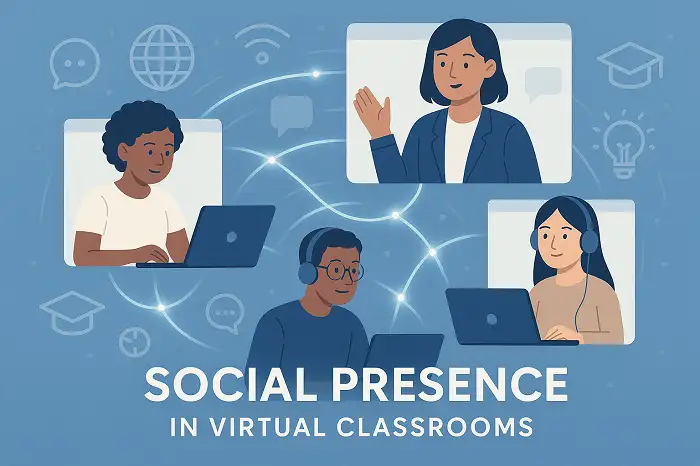
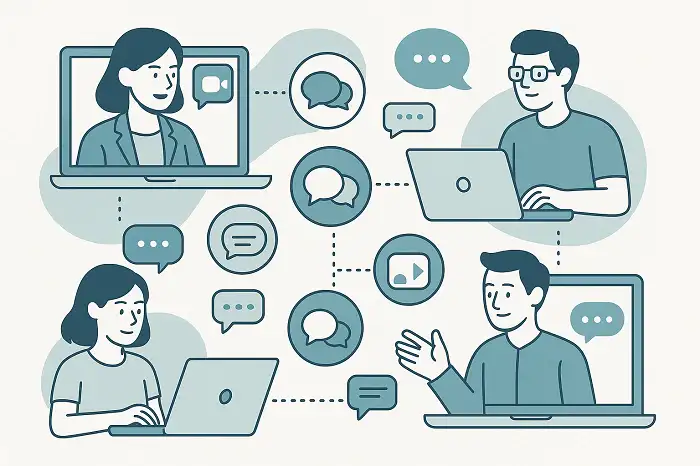
From the 1990s, CALL has been carrying the integrative label, thanks to the widespread use of multimedia products and the democratization of Internet use (Lamy & Hampel, 2007). In this genre of CALL, a variety of media, including graphics, text, hypertext, animation, video, sound, etc. became accessible in an integrated mode from a multimedia-networked computer (Lamy & Hampel, 2007). Unlike communicative CALL, in integrative CALL, the concept of L2 teaching and learning took a more relatively group-based form as a result of more emphasis being placed upon sociocultural considerations in education (Lamy & Hampel, 2007).
According to Gruba (2004), socio-collaborative approaches to teaching and learning are replacing communicative ones in CALL to account for more learner autonomy, collaborative project design and appropriate assessment practices. Gruba (2004) lists some of the most important potential developments for integrative CALL educators:
- Assist students to overcome anxieties fostered by extensive computer usage.
- Initiate and sustain student activity and interaction through computers; encourage and creative autonomous learning.
- Design new criteria for assessment that ensures equitable marking of group projects, accounts for computer skills and contends with individual learning goals.
- Take an active role in research and evaluation projects.
- Consider the sociopolitical impact of computer usage beyond the classroom.
- Acquire electronic literacy skills, including multimedia texts interpretation, basic materials design and production.
A tangible example of an integrative CALL program is the A to Z of Grammar program, which is based on the principle that a well-designed integrated approach to CALL needs to play a role in encouraging L2 learners to take responsibilities for their own learning as early as possible (McBride & Seago, 1996). The A to Z Grammar is a language learning program that brings together a range of resources or tools with a particular focus on assisting L2 learners in their acquisition and practice of grammatical structures and developing their linguistic awareness. It encourages the learners to select information and relate it to their individual needs to develop their self-confidence in solving an investigation and an ability to work independently.
Theory-Driven CALL
We can divide CALL specialists into two categories: (1) those who pay more attention to the technological dimension of CALL (e.g., Robb, 2006), and (2) those who consider its pedagogical dimension to be more important. About the former category, it is of primary importance to be familiar with all the current technologies that are available and feasible in the field of CALL. The teachers are highly recommended to update their information on how to use state-of-the-art technology in their online classes (Robb, 2006; Ward, 2006).

The view that CALL should be theory-driven is advocated by a number of authors and CALL practitioners in the CALL literature. Not surprisingly, given the range of CALL activities, and the evolving nature of the field, the theoretical motivation for CALL has been diverse. Theories emerging from cognitive psychology and SLA are a common point of departure (Farmer & Gruba, 2006; Hubbard, 2009; Kessler & Plakans, 2008; Levy, 1997; Stockwell, 2009).