Table of Contents
- Video of this Article on AI Use and Human Mind
- AI and the Question of Mental Laziness
- Does Relying on AI Reduce IQ or Brain Sharpness?
- How AI Could Actually Boost Human Intelligence
- Practicing Languages with AI-Powered Partners
- Finding Balance: Using AI Without Losing Mental Skills
- Brainstorming with AI for Smarter Decisions
- AI as the Inevitable Extension of the Human Mind
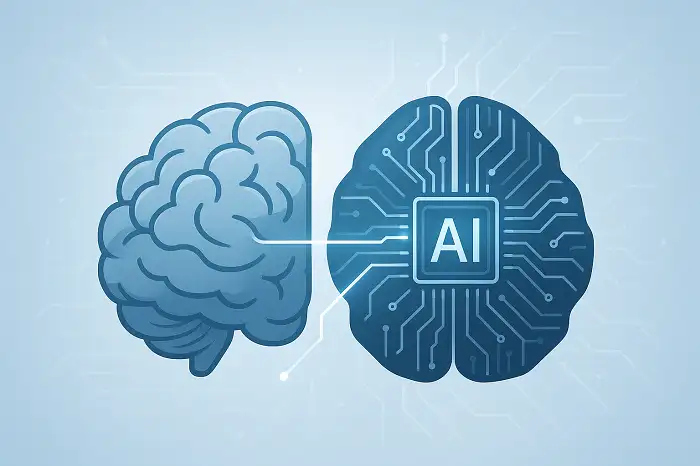
Artificial Intelligence (AI) is changing the way we think, work, and solve problems. From writing content to solving complex tasks, AI handles activities that once consumed significant mental energy. But could this convenience come at a cost? Some researchers warn that over-reliance on AI might encourage mental laziness, weaken memory, and reduce problem-solving skills, similar to how calculators reduced mental math practice. On the other hand, many experts believe AI can boost human intelligence by freeing mental resources for more creative and meaningful activities. The real challenge lies in how we use AI—either as a supportive tool or a substitute for active thinking.
Video of this Article on AI Use and Human Mind

AI and the Question of Mental Laziness
Artificial Intelligence has rapidly become a powerful companion in everyday life, helping people write essays, solve problems, translate languages, and even make complex decisions. With its growing role, many people now depend on AI for tasks that once demanded focus, memory, and problem-solving. This shift raises a crucial question: if machines handle so much of our thinking, will our own minds become less active and sharp?
Some argue that convenience can lead to over-reliance, encouraging mental laziness and weakening skills like critical thinking or creativity. Others believe AI does not replace the brain but rather enhances it by saving time and freeing mental resources for more meaningful activities. The truth may lie somewhere in between, depending on how we choose to integrate AI into our daily lives.
Does Relying on AI Reduce IQ or Brain Sharpness?
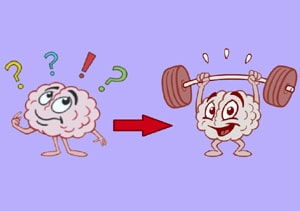
The concern that using AI might reduce IQ or weaken brain sharpness stems from how the human mind develops through practice and effort. Just as solving puzzles, reading critically, or performing mental math strengthens neural pathways, outsourcing these activities to machines could, in theory, limit mental exercise. For example, if students rely on AI to write essays or solve problems without engaging in the process themselves, they may miss opportunities to improve reasoning, creativity, and memory. Over time, this lack of practice could contribute to cognitive stagnation or what some call “mental laziness.”
At LELB Society, our registered students have composed nearly 250 IELTS essays entirely on their own, and each submission is carefully double-checked to ensure it is not AI-generated. This commitment preserves the authenticity of their work while encouraging genuine critical thinking and writing practice. After submission, other students and site members actively review these essays through our nested comment system, leaving constructive feedback and replies. This interactive exchange fosters collaborative learning, allowing participants to refine their skills, learn from one another, and engage in meaningful academic dialogue.
However, scientific evidence on AI directly lowering IQ is still lacking. Intelligence is shaped by many factors—education, environment, lifestyle, and genetics—not just technology use. While over-dependence on AI might discourage deep thinking, using it responsibly may have no negative effect at all. In fact, when AI is applied as a supportive tool rather than a replacement, it can stimulate curiosity and accelerate learning. The real issue is not whether AI inherently lowers IQ, but whether people allow it to substitute their own effort and critical engagement.
How AI Could Actually Boost Human Intelligence

While concerns about mental laziness are valid, many experts argue that AI has the potential to enhance human intelligence rather than diminish it. By automating repetitive or time-consuming tasks, AI allows people to focus on higher-order thinking skills such as creativity, critical analysis, and problem-solving. For instance, instead of spending hours gathering data, professionals can use AI to quickly process information and dedicate more energy to interpreting results and making strategic decisions. In education, AI-powered tools can personalize learning experiences, helping students strengthen weak areas while encouraging independent exploration and curiosity.
For example, Dr. Mohammad Hossein Hariri Asl, the founder of LELB Society, has significantly optimized our educational WordPress website by reducing the number of plugins to only three, while coding the remaining functionalities with AI assistance, particularly through dynamic conversations with ChatGPT. This innovative approach has made our platform faster, more secure, and highly optimized. With AI support, we have successfully implemented advanced features without relying on heavy plugins, including:
- Transferring our website from Apache server to Nginx
- SEO optimization without using any plugin
- Adding membership functionality to paywalled premium content
- Proofreading content before publishing
- Adding YouTube video schema in WordPress without a plugin
- Displaying related posts at the end of articles and bbPress forum topics
- Installing share buttons at the end of posts
Moreover, AI can serve as a cognitive partner that expands the limits of human capability. Just as calculators did not destroy mathematics but instead empowered scientists and engineers to tackle more complex problems, AI can free the brain from mundane tasks and open new pathways for innovation. Interacting with AI systems can spark new ideas, expose people to diverse perspectives, and accelerate the pace of research and creativity. When used responsibly, AI does not replace intelligence—it amplifies it, acting as a tool that helps humans reach their full cognitive potential.
Practicing Languages with AI-Powered Partners

With tools like Google AI Studio, language learners can now practice a second or foreign language with AI-driven partners that never grow tired. These virtual partners are available 24/7, offering consistent interaction and personalized support. Learners can request the AI to slow down its speech, making it easier for beginners to follow conversations and build listening comprehension step by step. At the same time, AI can provide instant and precise feedback on pronunciation, grammar, and vocabulary use—something that usually requires a skilled human teacher.
Beyond oral practice, AI also plays a vital role in assessing written performance. Advanced algorithms can analyze and score essays, offering corrections and suggestions similar to professional instructors but at a fraction of the cost. This makes high-quality language education more accessible, scalable, and affordable to learners worldwide. By combining tireless practice opportunities with accurate evaluation, AI-powered platforms help learners build confidence and competence in their target language more efficiently than ever before.
Finding Balance: Using AI Without Losing Mental Skills
The key to benefiting from AI without risking mental laziness lies in striking a healthy balance. Instead of letting AI handle every task, individuals should consciously decide when to rely on it and when to engage their own skills. For example, using AI to check grammar is helpful, but writing and editing independently first ensures that creativity and language ability continue to grow. Similarly, students can use AI to clarify complex topics, but they should still practice problem-solving on their own to strengthen critical thinking and memory retention. Treating AI as a supportive assistant rather than a complete replacement keeps the brain actively involved.
Developing habits that encourage active learning alongside AI use is also important. Setting aside time for activities that challenge the brain—like reading, writing, mental math, or brainstorming—helps maintain sharpness. Engaging in discussions, solving puzzles, or learning new skills ensures the mind stays resilient, even in an AI-driven world. In this way, people can enjoy the efficiency and convenience of AI while continuing to nurture their own intelligence, creativity, and problem-solving abilities. Balance ensures that AI becomes a tool for empowerment, not a shortcut to complacency.
Brainstorming with AI for Smarter Decisions

AI can serve as a powerful brainstorming partner, helping people tackle complicated and multifaceted issues in a conversational form. By engaging with AI interactively, users can practice critical thinking, problem-solving, and decision-making while leveraging machine intelligence in a highly practical way. Instead of replacing human thought, AI becomes a catalyst for deeper reflection, offering perspectives, ideas, and solutions that users can evaluate critically. This collaborative process allows individuals to refine their reasoning while making more informed choices.
For instance, Dr. Mohammad Hossein Hariri Asl, the founder of LELB Society, engages in daily conversations with ChatGPT to plan and enhance LELB Society’s services, functionalities, user interface, user experience, speed, optimization, security, and infrastructure. This ongoing rapport with AI has not only made Dr. Hariri Asl more analytical and sharper in his thinking but has also transformed LELB Society into a far more advanced and efficient educational platform compared to its earlier version before the adoption of AI. In this way, brainstorming with AI becomes a dual benefit: sharpening the human mind while simultaneously driving organizational growth and innovation.
AI as the Inevitable Extension of the Human Mind

With the complexity of today’s interconnected world, shaped by the internet and globalization, it is nearly impossible to imagine life without artificial intelligence. AI has become an essential extension of the human mind, enabling people to process vast amounts of information, make faster decisions, and adapt to challenges that would otherwise be overwhelming. Much like electricity transformed daily life in the past, AI now plays a similar role in the third millennium by powering systems that keep societies efficient, innovative, and connected.
Rejecting AI altogether would be as impractical as lighting homes with candles in the age of electricity. Instead, the challenge lies in learning how to integrate AI responsibly and intelligently into everyday life. Far from being a passing trend, AI is a permanent feature of modern civilization, serving as a tool to augment human abilities rather than replace them. Recognizing its inevitability allows us to shift the conversation from whether we should use AI to how we can use it most effectively to support progress and well-being.