
Table of Contents
- Video of Social Presence and Student Interaction
- Student Interaction and Involvement
- Linguistic Characteristics of CMC
- Negotiation and Linguistic Modification
- Patterns of Participation
- The Teacher’s Role in Facilitating Involvement
- Social Presence
- Defining Social Presence: From Media to People
- Participant Behavior Over Medium
- The Building Blocks of Online Community
- Collaborative Learning and a Sense of Belonging
- References
Explore the critical role of social presence and student interaction in online language learning environments. This article delves into how computer-mediated communication (CMC) reshapes participation, examining linguistic complexity, negotiation patterns, and the shift toward more balanced classroom discourse. It contrasts early theories that emphasized communication media with modern views that prioritize participant behavior in developing a sense of community. Discover how collaborative learning, built on trust and interpersonal relationships, fosters belonging and deepens the learning experience, and learn about the evolving responsibilities of online teachers in facilitating meaningful student involvement.
Video of Social Presence and Student Interaction

Student Interaction and Involvement
CMC provides a wealth of easily accessible data for language researchers who study student interaction (Warschauer, 2001). From this perspective, CMC is closely studied in the following three subcategories:
Linguistic Characteristics of CMC
L2 research has shown that computer-assisted conversation is syntactically more complex and lexically denser than face-to-face conversation (Warschauer, 1996).
Negotiation and Linguistic Modification

Research has indicated that the types of tasks and topics that are selected have a significant effect on the nature of computer-mediated negotiation, with substantial benefits from conversational tasks which are goal-oriented and encourage learners to reflect upon their own use of language (Lamy & Goodfellow, 1999).
Patterns of Participation
Studies of L2 classroom discourse have proved that student participation increases dramatically in computer-mediated communication in a more balanced and equal fashion in comparison to face-to-face student interaction (Warschauer, 2001).
The Teacher’s Role in Facilitating Involvement

An online English teacher in the third millennium is to assume some particular responsibilities in order to achieve efficacy in teaching. Warschauer et al. (1996) note that a CMC teacher is responsible for handling the new teacher-student and student-student interaction in the networked classroom. With the intention of facilitating student involvement in the computer culture, teachers are supposed to be actively present in the networked project. Warschauer et al. (1996) continue that teacher involvement does not necessarily equal teacher dominance.

Many online language learning providers recognize the fact that students sometimes need direct interaction with teachers to learn a new language. As such, according to Beatty (2003), they promote blended learning solutions in which students meet each other and their teachers regularly in actual chatrooms with instructions.
Social Presence
Defining Social Presence: From Media to People
The concept of social presence is not new. Short, Williams and Christie (1976, as cited in Palloff & Pratt, 2007) defined social presence as the degree to which a person is perceived as real in communication that is conducted via the use of some form of media. They believed that the degree of developed presence was attributable to the particular media in use. Short et al. (1976, as cited in Lowenthal, 2009) conceptualized social presence basically as a quality of a particular channel of communication that influences the way people interact with each other.
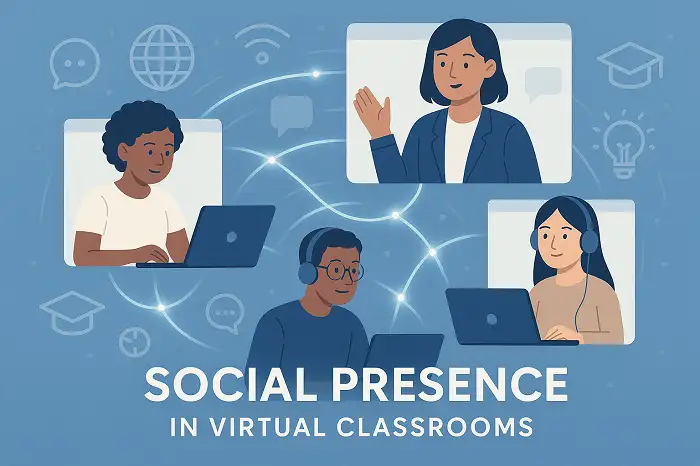
The leading proposers of social presence placed more emphasis upon communication media rather than people. However, more recently, scholars, including (Gunawardena, 1995; Gunawardena & Zittle, 1997, as cited in Cobb, 2009; Hauck & Warnecke, 2013; Kehrwald, 2008; Palloff & Pratt, 2005/2007; Picciano, 2002; Richardson & Swan, 2003; Swan & Shea, 2005; Tu, 2001/2002; Tu & McIsaac, 2002) have reconceptualized the theory of social presence by giving more consideration to the people in comparison to the channel of communication. For instance, Swan and Shea (2005) prescribe discussion facilitation instead of discussion leadership as one of the significant roles of online teachers in the recent genre of social presence theory, and Hauck and Warnecke (2013) and Kehrwald (2008) define social presence as the ability of the individual to demonstrate their availability and willingness to take part in social and interactive activities.
Participant Behavior Over Medium

As stated in the preceding two paragraphs, more recently, studies on social presence in online learning have indicated that – unlike the previous beliefs – the medium has little to do with developing a sense of presence. In other words, according to Lombard and Ditton (1997, as cited in Palloff & Pratt, 2007), the emergence of social presence depends – to a high degree – on how well participants fail to acknowledge or are able to ignore the presence of the medium. That is to say, it is participant behavior, rather than media, that appears to have a more profound impact on the development to presence in online learning.
The Building Blocks of Online Community
Social presence or “a feeling of community or connection among learners” (Palloff & Pratt, 2005, p. 7) has been correlated with learner satisfaction (Gunawardena, 1995) as well as a sense of belonging to the online community (Picciano, 2002) that impacts learners’ online interaction (Tu, 2002; Tu & McIsaac, 2002). Social presence is viewed as a degree of awareness of another person in an online setting and a consequent appreciation of online interpersonal relationships (Hauck & Warnecke, 2013; Tu, 2002; Walther & Burgoon, 1992). Tu (2002) catalogues interpersonal relationship, trust, learners’ perceptions on online environments, learner’s computer literacy and communication styles, attributes of communication media, task types, privacy, etc. as the building blocks of online social presence. As a matter of fact, developing a social presence is an integral part of creating a successful learning community because it is a measure of the feeling of community that a learner experiences in an online environment (Tu & McIsaac, 2002).
Scholars in the field of distance learning argue that CMC and online education can make a crucial contribution to the social practice of learning, although relational and nonverbal cues are not accessible as much as face-to-face communication (Gunawardena, 1995; Gunawardena & Zittle, 1997, as cited in Cobb, 2009; Picciano, 2002; Tu, 2001; Tu & McIsaac, 2002; Walther, 1996).
Collaborative Learning and a Sense of Belonging

The creation of a successful learning community is at the heart of developing a sense that the members have a belonging to each other and matter to one another and to the group, and a shared faith that the member’s needs will be satisfied through their commitment to be together, a phenomenon which is referred to as collaborative learning (McMillan & Chavis, 1986; Palloff & Pratt, 2005; Picciano, 2002).
McMillan and Chavis (1986) insist that a successful learning community must be equipped with the following principles to be able to fulfill its main objectives: comprising, a feeling of belonging, the ability to influence the group, fulfillment of needs through shared values and goals, and a shared connection with others in the group. These principles, according to Hall and Herrington (2010), are fundamentally based on social presence. According to Palloff and Pratt (2005), collaborative learning provides the students with exceptional opportunities to extend and deepen their learning experience and explore new ideas through sharing them with each other in the group while receiving critical and constructive feedback.
References
- Cobb, S. C. (2009). Social presence and online learning: A current view from a research perspective. Journal of Interactive Online Learning, 8(3), 241-254.
- Gunawardena, C. (1995). Social presence theory and implications for interaction and collaborative learning in computer conferences. International Journal of Educational Telecommunications, 1(2-3), 147-166.
- Hall, A., & Herrington, J. (2010). The development of social presence in online Arabic learning communities. Australasian Journal of Educational Technology, 26(7), 1012-1027.
- Hauck, M., & Warnecke, S. (2013). Materials design in CALL: Social presence in online environments. In M. Thomas, H. Reinders & M. Warschauer (Eds.), Contemporary computer-assisted language learning (pp. 95-115). London, UK: Bloomsbury Academic.
- Kehrwald, B. (2008). Understanding social presence in text-based online learning environments. Distance Education, 29(1), 89-106. doi:10.1080/01587910802004860
- Lamy, M. N., & Goodfellow, R. (1999). Reflective conversation in the virtual language classroom. Language Learning & Technology, 2(2), 43-61.
- Lowenthal, P. R. (2009). The evolution and influence of social presence theory on online learning. In T. T. Kidd (Ed.), Online education and adult learning: New frontiers for teaching practices (pp. 124-139). Hershey, PA: IGI Global. doi:10.4018/978-1-60566-830-7.ch010 221 INTERACTIVITY AND SOCIAL PRESENCE IN CALL
- McMillan, D. W., & Chavis, D. M. (1986). Sense of community: A definition and theory. Journal of Community Psychology, 14(1), 6-23. doi:10.1002/1520.6629(198601)14:1%3C6::aid-jcop2290140103%3E3.0.co;2-i
- Palloff, R. M., & Pratt, K. (2005). Collaborating online: Learning together in community. San Francisco, CA: Jossey-Bass.
- Palloff, R. M., & Pratt, K. (2007). Building online learning communities: Effective strategies for the virtual classroom. San Francisco, CA: John Wiley & Sons, Inc. 223 INTERACTIVITY AND SOCIAL PRESENCE IN CALL
- Picciano, A. G. (2002). Beyond student perceptions: Issues of interaction, presence, and performance in an online course. JALN, 6(1), 21-40.
- Richardson, J. C., & Swan, K. (2003). Examining social presence in online courses in relation to students’ perceived learning and satisfaction. JALN, 7(1), 68-88.
- Swan, K., & Shea, P. (2005). The development of virtual learning communities. In S. R. Hiltz & R. Goldman (2005), Learning together online: Research on asynchronous learning networks (pp. 239-261). Mahwah, NJ: Lawrence Erlbaum Associates, Inc. 227 INTERACTIVITY AND SOCIAL PRESENCE IN CALL
- Tu, C. H. (2001). How Chinese perceive social presence: An examination of interaction in online learning environment. Educational Media International, 38(1), 45-60.
- Tu, C. H. (2002). The relationship between social presence and online privacy. Internet and Higher Education, 5(4), 293-318. doi:10.1016/s1096-7516(02)00134-3
- Tu, C. H., & McIsaac, M. (2002). The relationship of social presence and interaction in online classes. The American Journal of Distance Education, 16(3), 131-150. doi:10.1207/s15389286ajde1603_2
- Walther, J. B. (1996). Computer-mediated communication: Impersonal, interpersonal, and hyperpersonal interaction. Communication Research, 23, 3-43. doi:10.1177/009365096023001001
- Walther, J. B., & Burgoon, J. K. (1992). Relational communication in computer-mediated interaction. Human Communication Research, 19(1), 50-88. doi:10.1111/j.1468-2958.1992.tb00295.x
- Warschauer, M. (1996). Comparing face-to-face and electronic communication in the second language classroom. CALICO Journal, 13(2), 7-26.
- Warschauer, M. (2001). On-line communication. In R. Carter & D. Nunan (Eds.), The Cambridge guide to teaching English to speakers of other languages (pp. 207-212). Cambridge: Cambridge University Press. doi:10.1017/cbo9780511667206.031