Table of Contents
- Video of Key Terms in CALL, CMC, and Online Language Learning
- Asynchronous CMC
- Computer Assisted Language Learning (CALL)
- Computer-mediated Communication (CMC)
- Content-based Instruction (CBI)
- Integrative CALL
- Interactivity
- Negotiation of Meaning
- Online Communication
- Peer Assessment
- Social Context
- Social Presence
- Synchronous CMC
- References
Understanding the key terms in Computer-Assisted Language Learning (CALL) and Computer-Mediated Communication (CMC) is essential for exploring how technology enhances second language education. This article defines crucial concepts such as asynchronous and synchronous CMC, integrative CALL, interactivity, social presence, and peer assessment. By clarifying these foundational terms, readers gain deeper insights into the role of online communication, collaboration, and learner autonomy in modern language classrooms. These definitions provide a solid basis for both research and practice in digital language learning.
Video of Key Terms in CALL, CMC, and Online Language Learning

Asynchronous CMC
If the data and language products are typed and stored for numerous sorts of analyses, such as self-corrections, pause-time, dictionary look-up use, reflection, feedback, etc., then we are dealing with an asynchronous type of CMC (Gass & Selinker, 2008). In this study, asynchronous CMC is majorly practiced via posting, commenting and replying on the part of the teachers and students. Two obvious examples of asynchronous CMC are (1) the student-student interactivity on our comment forms prior to any round table session, and (2) our Question-and-Answer Forum in which the students pose their English questions and the teacher or other students would respond to them.
Computer Assisted Language Learning (CALL)

CALL is defined as the search for and study of applications of the computer in the field of language teaching and learning (Levy, 1997). CALL covers a broad spectrum of concerns, including the pedagogies implemented through technology and their evaluation. As a consequence, CALL draws from other areas within and beyond applied linguistics for conceptual and technical tools to account for and evaluate computer-based learning (Chapelle, 2001). In this interactive and integrative network-based investigation, CALL refers to a specific orientation toward employing computers and cyber-technology for the sake of learning English as a second language online with a particular emphasis on establishing an interactive and collaborative learning environment. It is important to note that in this study, as it is typical of any integrative CALL system, the student-student interaction patterns are prioritized over sheer utilization of technology (McBride & Seago, 1996).
Computer-mediated Communication (CMC)

CMC is a research area regarding communication that takes place among human beings through the instrumentality of computers (Herring, 1996). CMC includes email, video-conferencing, Internet Relay Chat (IRC), commenting, posting, etc. because it investigates the nature of communication via text, audio and video on computers (Harrington & Levy, 2001). In this study into the field of integrative CALL, CMC makes a reference to the facilitative and enabling impact of computers that is conducive to the creation of an effective network-based learning environment and optimization of student interactivity. That is to say, the L2 learners engaging in some communicative activities, namely collaborative writing, argue for/against, and round table, are encouraged to maximize computer technology for educational purposes to learn with and from each other.
Content-based Instruction (CBI)

CBI refers to the teaching of language by exposing the students to content that is interesting and relevant to them (Brinton, 2003). Through CBI, language becomes the medium to convey informational content of interest and relevance to the learner. Language takes on its appropriate role as a vehicle for accomplishing a set of content goals (Brown, 2007). In this study, the researcher endeavors to call the attention of the students to informative and thought-provoking subjects, such as stress, global village, workaholism, immigration, insomnia, carpe diem, etc., to augment the level of their motivation, activeness and interactivity. Furthermore, the L2 learners are inspired to assume active responsibilities in developing the main content of our conversation class, especially round table sessions, through posing questions to each other and replying to them asynchronously in our comment forms and discussion boards.
Integrative CALL

Integrative CALL is the most recent genre of CALL in which socio-collaborative approaches to teaching and learning are replacing the communicative ones to account for more learner autonomy, collaborative project design and appropriate assessment practices (Gruba, 2004). In this research, it is attempted to create an opportunity for the L2 learners to optimize their both communication and individualization at the same time through encouraging them to augment their interaction with the other students especially by commenting, voting for/against, replying, etc., and increasing their reflectivity and autonomy through developing the content of the course and practicing self- and peer-assessment in our comment forms and discussion boards prior to each synchronous class. That is to say, not only will the students become interactive and communicative (Communicative CALL), but they will also become autonomous and individualized (Integrative CALL).
Interactivity

Interactivity includes the activities in which CMC users engage and the communication styles they use, namely task types, topics (Argyle & Dean, 1965), responsive time, immediacy in online interaction (Baker, 2010; Cobb, 2009; Tu, 2002), exchange of feedback, and the size of online communities (Swan, 2002; Tu, 2001/2002; Tu & McIsaac, 2002). Gunawardena (1995) argues that interactivity refers to the required design and strategy to trigger social presence. In this study, it refers to the collaborative activities that the L2 learners and the researcher engage in to fulfill group-based tasks and activities, namely round table and collaborative writing, with a particular emphasis on practicing asynchronous peer-assessment. As a result, interactivity, in this inquiry, implies social activeness, as opposed to individualization, on the part of the students.
Negotiation of Meaning

“Negotiation for meaning and especially negotiation work that triggers interactional adjustments by the NS or more competent interlocutor facilitates acquisition because it connects input, internal learner capacities, particularly selective attention, and output in productive ways” (Long, 1996, pp. 451-452). If teachers can guide students through getting into the right kinds of conversations, online conversations and discussions could extend the opportunities beyond what the learners can do in the traditional classrooms, and the virtual venues would become ideal for practicing negotiation of meaning (Chapelle & Jamieson, 2008). In this research, the students will practice a great deal of negotiation of meaning both asynchronously (in our comment forms and discussion boards) and synchronously (in our voice-based argue for/against and round table sessions) to ask for clarification because, on the one hand, this is the students who are the principal content developers of the course, and on the other hand, these responsible students are supposed to arrive at a conclusion at the end of each conversation class with reference to their negotiations. Moreover, the ongoing and open stream of asynchronous activities on our blog could make it feasible for the learners to exercise negotiation of meaning continuously and recursively in a nested or threaded form.
Online Communication

Online communication is concerned with the attributes of the language used online and the applications of online language (Tu & McIsaac, 2002). To be successful online communicators, L2 learners need to develop some text-based skills, namely typing, reading and writing (in general, computer literacy) because without these skills, students will develop communication anxiety (Gunawardena, 1991, as cited in Tu & McIsaac, 2002). In this research, online communication refers to the administrative, instructional and managerial affairs provided by the teacher with the intention of generating a sense of belonging in the students. For instance, teacher-assessment is intentionally delayed and performed only after students’ self-assessment and peer-assessment. In addition, the teacher’s presence in the community and his immediacy in our asynchronous activities are consciously controlled to promote more student-driven online communication.
Peer Assessment

Peer assessment and feedback can encourage a collaborative dialogue in which two-way feedback is established, and meaning is negotiated between the two parties. It triggers highly complex socio-cognitive interactions involving arguing, explaining, clarifying and justifying (Rollinson, 2005). In this research, the students are encouraged to monitor their own learning (self-assessment) and also that of their classmates (peer-assessment) through commenting, self-editing and replying to the comments of their peers, etc., which per se might increase the level of interaction among the learners. To prompt an abundance of asynchronous peer-assessment, teacher-assessment is delayed and regarded only as a last resort. Asynchronous activities on our comment forms and discussion boards equipped with a voting system and threaded or nested commenting could facilitate the process of peer-assessment.
Social Context

Social contexts, such as task orientation, privacy, topics, recipients/social relationships, and social process contribute to the degree of social presence (Tu & McIsaac, 2002). In this socially oriented inquiry, it is attempted to provide a socially interactive setting for the participants to make a substantial contribution to the online community through sending private messages to each other, instant messaging (chatting), polling, commenting, posting, replying, attending forums, and so forth. This social context is set up in a way that provides the L2 learners with a private network of communication to ensure a more secure interactive atmosphere through account creation and using usernames and passwords on the part of the students with the researcher’s approval.
Social Presence

Social presence is defined as the degree of salience of another person in an interaction and the consequent salience of an interpersonal relationship (Short, Williams & Christie, 1976, as cited in Tu, 2001). A more recent definition of the social presence theory was offered by Gunawardena (1995) as the degree to which a person is perceived as a real person in mediated communication. Social presence, which is an integral element of student satisfaction (Tu, 2001), is differentiated from interactivity in the sense that it requires the learners to perfect and complete their interactivity with awareness (Gunawardena, 1995). That is to say, when learners notice and appreciate this superior level of awareness to interactivity, they can perceive and experience genuine social presence.
In this study, generating a sense of social presence among the L2 learners in our CALL program is definitely the ultimate objective, and it will be attempted to fulfill this goal through raising the L2 learners’ awareness level of the presence of their classmates, albeit online, in order to have interaction with them, especially asynchronously and in our comment forms and discussion boards. The elevation of the students’ awareness is to be fulfilled by exposing them to challenging and informative topics (Argyle & Dean, 1965) that require them to have interpersonal relationships with each other (Walther & Burgoon, 1992) to practice negotiation of meaning so as to achieve a sense of satisfaction (Gunawardena, 1995; Gunawardena & Zittle, 1997, as cited in Cobb, 2009)
Synchronous CMC
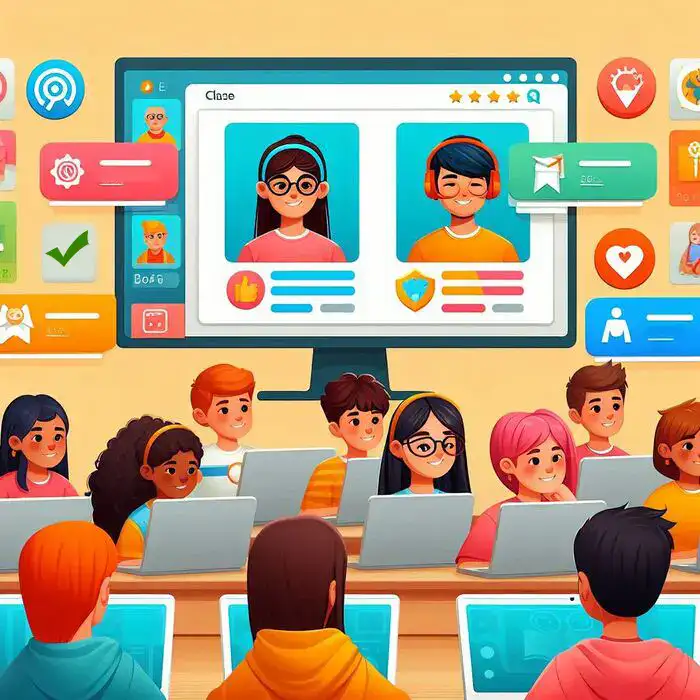
Students interact with each other and the teacher at the same time through chatting, video or voice conferencing, streaming, etc. It has been argued that SCMC interactions provide learners with more additional processing and planning time than face-to-face interactions (Smith, 2003; Smith & Gorsuch, 2004). In addition, SCMC may provide learners with enhanced visual saliency of complex or low-salience forms (Smith, 2003; Smith, 2010, as cited in Mackey, 2012). The participants in this research will experience SCMC via instant messaging or chatting and participating in our online classes in the form of voice conferencing on Skype and Discord in our round table and argue for/against sessions.
References
- Argyle, M., & Dean, J. (1965). Eye-contact, distance and affiliation. Sociometry, 28(3), 289-304. doi:10.2307/2786027
- Baker, C. (2010). The impact of instructor immediacy and presence for online student affective learning, cognition, and motivation. The Journal of Educators Online, 7(1), 1-30. 209 INTERACTIVITY AND SOCIAL PRESENCE IN CALL
- Brinton, D. (2003). Content-based instruction. In D. Nunan (Ed.), Practical English language teaching (pp. 199-224). New York, NY: McGraw Hill. 210 INTERACTIVITY AND SOCIAL PRESENCE IN CALL
- Brown, H. D. (2007). Teaching by principles: An interactive approach to language pedagogy (3rd ed.). New York, NY: Pearson Education Inc.
- Chapelle, C. A. (2001). Computer applications in second language acquisition: Foundations for teaching, testing and research. Cambridge: Cambridge University Press.
- Gass, S. M., & Selinker, L. (2008). Second language acquisition: An introductory course. New York, NY: Routledge.
- Chapelle, C. A., & Jamieson, J. (2008). Tips for teaching with CALL: Practical approaches to computer-assisted language learning. New York, NY: Pearson-Longman. 211 INTERACTIVITY AND SOCIAL PRESENCE IN CALL
- Cobb, S. C. (2009). Social presence and online learning: A current view from a research perspective. Journal of Interactive Online Learning, 8(3), 241-254.
- Gruba, P. (2004). Computer assisted language learning (CALL). In A. Davies & C. Elder (Eds.), The handbook of applied linguistics (pp. 623-648). Malden, MA: Blackwell Publishing, Ltd. doi:10.1002/9780470757000.ch25
- Gunawardena, C. (1995). Social presence theory and implications for interaction and collaborative learning in computer conferences. International Journal of Educational Telecommunications, 1(2-3), 147-166.
- Harrington, M., & Levy, M. (2001). CALL begins with a “C”: Interaction in computer-mediated language learning. System, 29, 15-26. doi:10.1016/s0346-251x(00)00043-9
- Herring, S. (1996). Computer Mediated Communication: Linguistic, social and cross-Cultural Perspectives. Amsterdam, Netherlands: John Benjamins.
- Levy, M. (1997). Computer-assisted language learning: Context and contextualization. Oxford: Oxford University Press.
- Long, M. H. (1996). The role of the linguistic environment in second language acquisition. In W. C. Ritchie & T. K. Bhatia (Eds.), Handbook of research on language acquisition (pp. 413-468). New York, NY: Academic Press. doi:10.1016/b978-012589042-7/50015-3
- Mackey, A. (2012). Input, interaction, and corrective feedback in L2 learning. Oxford: Oxford University Press.
- McBride, N., & Seago, K. (1996). The A to Z of grammar: An integrated CALL project. Computer Assisted Language Learning, 9(1), 45-61. doi:10.1080/0958822960090103
- Rollinson, P. (2005). Using peer feedback in the ESL writing class. ELT Journal, 59(1), 23-30. doi:10.1093/elt/cci003 225 INTERACTIVITY AND SOCIAL PRESENCE IN CALL
- Smith, B. (2003). The use of communication strategies in computer-mediated communication. System, 31, 29-53. doi:10.1016/s0346-251x(02)00072-6
- Smith, B., & Gorsuch, G. J. (2004). Synchronous computer mediated communication captured by usability lab technologies: New interpretations. System, 32, 553-575. doi:10.1016/j.system.2004.09.012
- Swan, K. (2002). Building learning communities in online courses: The importance of interaction. Education, Communication & Information, 2(1), 23-50. doi:10.1080/1463631022000005016
- Tu, C. H. (2001). How Chinese perceive social presence: An examination of interaction in online learning environment. Educational Media International, 38(1), 45-60.
- Tu, C. H. (2002). The relationship between social presence and online privacy. Internet and Higher Education, 5(4), 293-318. doi:10.1016/s1096-7516(02)00134-3
- Tu, C. H., & McIsaac, M. (2002). The relationship of social presence and interaction in online classes. The American Journal of Distance Education, 16(3), 131-150. doi:10.1207/s15389286ajde1603_2
- Walther, J. B., & Burgoon, J. K. (1992). Relational communication in computer-mediated interaction. Human Communication Research, 19(1), 50-88. doi:10.1111/j.1468-2958.1992.tb00295.x